Disclaimer: I received an advanced reader copy (ARC) of this book for free for the purpose of giving an honest review.
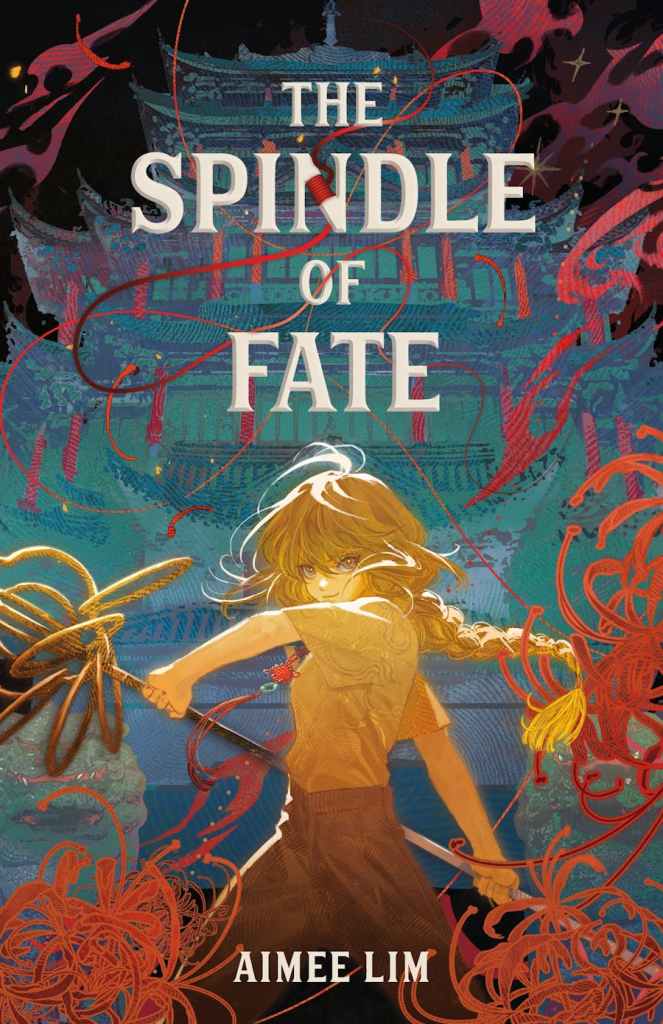
The Spindle of Fate can be purchased here.
***SPOILERS***
New author Aimee Lim’s The Spindle of Fate is a middle grade fantasy drawing on an old Buddhist tale, Mulian Saves His Mother From Hell. It tells the story of Evie Mei Huang, a 12-year old girl who descends into the Chinese underworld to rescue her dead mom, who turns out to have been part of a secret magical society. Both educational and entertaining, the overarching narrative serves as a vessel to share a sampler of Chinese myths, folk tales, history, and language tidbits as it follows vengeful antihero Evie into Hell.
Personally, I think this book is horror disguised as fantasy. From depicting the Huang’s petty bourgeois world where even the magic system functions as a family business, to the literal pond of blood the kiddos have to swim in, it sets some deeply unsettling scenes. Evie herself is a horror movie fan, so I feel like it’s intentionally nudging at that genre, even if the book had to get marketed as plain fantasy. I would still say it’s appropriate for its proposed 8-12 year-old audience, as a kid that loved horror at that age myself—just a head’s up that it’s more Dante than Rick Riordan.
Evie reminded me of one of Roald Dahl’s spiteful characters, and was fun to read precisely because she’s not “good.” She doesn’t seem to like anyone, even her supposed best friend, and has a particularly carceral/punitive ethics driving her every move. Despite being given strong evidence to the contrary, Evie can’t wrap her head around the idea that the cycle of violence is bad. Instead, in order to overcome the cognitive dissonance of seeing innocent people harmed, she decides to believe they must be guilty in some way. When that fails, she allows herself to enjoy their suffering simply because she likes it. She even engages in some torture of innocents herself, using a magic staff that her forebearer Mulian once used to liberate people. Lol. One of the book’s themes is capitalist ethics superseding other values systems the Huang’s Chinese ancestors upheld, so this checks out.
At the end of the book, in one of the most psychologically disturbing moments to me, Evie is forced to smile and shake the hand of the guy who murdered her mom. Her mom’s ghost, demonstrating lackluster ethics, had made her swear not to avenge her death not because killing people is wrong, but because you might go to prison for it. But the conclusion of the book, and Evie’s almost nonexistent character arc, is that since she doesn’t believe in filial piety, she is gonna freaking murder this guy anyway, against her mom’s wishes.
I was a little confused by this ending, as the story felt like it was setting up a moment of reckoning where Evie realized, through several illustrative metaphors and potential lessons from past and present, that the best way to “avenge” her mom is actually to refuse to continue this cycle. For example, her sidekick is a boy who barely gets to see his mom because she’s off on her own revenge quest all the time. But Evie sees and then overlooks this. It’s like Hamlet if Hamlet didn’t die at the end, and decided to go on killing more people, without any repercussions for his actions.
It left me wondering what I’m supposed to take away from the story—that it’s actually a good thing to seek revenge? That everyone else was wrong and Evie was right? That money really does come before everything (for example, the only argument that showed signs of convincing Evie not to kill somebody was when she considered how it might affect online reviews of the family’s business—lmao). I’d be curious to hear how others interpret this story’s message.
One other thing that bugged me was how a last minute introduction of a bisexual character was handled. At the very end, the boy character, Kevin, gets his wish to know who he’s fated to marry. The problem is, he’s informed of his fated mate, at twelve years old, in front of a crowd of adults we don’t know much about, and it’s another boy. This is presented as totally fine. But I felt visceral shock that an adult would out him publicly in front of other adults, not only that but ones who had been shown throughout the story to be committed to a lot of traditional values and in some cases were particularly violent. When the rest of the book mentions things like colonialism and sexism, I assume homophobia exists in the world too.
I also would have preferred if the story more meaningfully engaged with Kevin’s sexuality. Like have him discover this aspect of himself through the course of the story—have him love—rather than through an adult telling him what he is at the end of the book.
But I’m still glad that such a character is on the page at all, which is a big change from when I was Kevin’s age. I’m thankful Aimee Lim wanted to make this gesture towards queer kids to let them know they’re welcome. And if the book becomes a series as it’s been set up to be able to do, I’m sure Lim would be able to expand on things like giving Evie and Kevin both more character development, and working out some of these things that felt a little underbaked.
All in all, I would recommend this book not only to young readers, but to their older friends, family, and teachers—there’s a lot here to use as a springboard for learning about other stuff together, like Chinese history and mythology, so I could see this book landing on school reading lists. Congrats to Aimee Lim on getting published—she’s a librarian, so I can imagine there will be a super cool moment when she gets to shelve the book she herself wrote!
This was my first Advanced Reader Copy review so I’m still learning the ropes, and I think I went more into analyzing the characters I was fascinated with than giving the overview someone deciding whether or not to read the book needs, but I’ll work on improving my approach for the next one.
Buy the Spindle of Fate here!
 AUSTIN DEWAR