“A Fine Balance,” by Charlotte Ashley – Analysis and Plot Beat Sheet


“A Fine Balance” came out in 2016, but I have it in an anthology and recently did a deep dive analysis of the story structure. Sharing my notes here in case anyone else finds this helpful—I talk about the significance of character names, meta themes, an interestingly passive twist on a heroic figure, and outline what makes these action scenes so tight and explosive.

You can read or listen to the short story via PodCastle!

  1. Synopsis
  2. Concept / Passive heroism
  3. Structure analysis
  4. Worldbuilding / Themes
  5. Significant Names
  6. Plot Beat Sheet / Story Structure Breakdown

Synopsis

Set in a fantasy version of the Ottoman Empire, the story is told by Emin Akdari, apprentice to a Kavalye, a duelist whose engagements with her rival from the opposing ethnic group not only provide entertainment, but play a critical political-economic role in maintaining equilibrium within a divided city. Because of this unique tradition, the city doesn’t know war, and has literally not invented the concepts of “soldiers” or armies yet. However, the balance has been upset, and the city is on the verge of a crisis because the two top duelists are so godmode and their prize money so high, that either one winning stands to destroy the whole system.

The main character seems to tag along simply supporting her mistress’ mission, while being somewhat of a lackluster apprentice duelist themself. But at the climactic moment, we see that it’s just that loyalty, that diligent service, which saves the day.

Concept / Passive heroism

What’s special about this story is an intriguing story structure which refuses to “stand on only two pillars,” as the main character says. Instead of having a hero and an antagonist, there’s a compound cast of heroes: the POV main character, their mentor, their mentor’s rival, and being generous and taking the story’s moral to heart, all the characters that assist them along the way—doctors and messengers and witnesses.

On the surface, the “true” hero, the POV main character, directly undermines standard protagonist conventions: they take a backseat to their mentor, who seems like the real hero of the action, to the point of straight up curling into the fetal position to hide at the climax of the story. They have their own lengthy combat scene, but it’s almost completely irrelevant to the plot (it does a little characterization mainly)—a good example of, if something is interesting enough, it doesn’t need to strictly follow the “rules” of plotting. The main character doesn’t even get a gender. One might assume they’re a woman, as all the duelists in the world seem to be, though it’s ambiguous since their name, at least in the real language it’s pulled from, means “young man.”

However, Emin serves the role of hero in two humble, yet critical, ways. First, by their singular virtue of being a reliable servant of their mistress, encapsulated in a ritual: every day, they clean and prep their mistress’ gun, even though she never uses it. This obedient and diligent practice ends up saving the day when the time suddenly comes to use the gun. But the second and lasting way the POV main character is the hero, as is suggested at the end of the story, is by simply being Witness to the events recounted, as many others were. This witnessing and then testifying to others teaches the city, persisting through future generations long after the heroes of the story are gone, the values the heroes stood for, thus inspiring perpetual peace.

Structure analysis

On a structural level (see full breakdown below), the story does this cool thing by having the decisive action of the climax, the decisive “heroic action” of the protagonist, occur in the opening lines of the story. Only, you don’t know its significance until the end, and spend the rest of the story thinking how our “hero” isn’t heroic at all, in comparison to the superhero-esque duelists. It’s Chekhov’s gun—gun included—but with a unique spin.

There’s a lot to learn from this story about writing action scenes, as well. I’m holding onto this one for future reference writing combat beats. I break them down in the outline below, so check that out there.

I’ve been studying basic stuff like the 3 (or 4) act structure, but that’s geared towards novels and screenplays, so it’s interesting to see where short story structures diverge from or condense these points. In this case, I identify 6 acts – Setup, Part One, Interlude, Part Two, Part Three, and Resolution/Summing-Up. These parts roughly follow the given breaks in the story, with one exception. But you might also divide the story into these broad beats: Hook, Setup, First Battle, Interlude, Second Battle, Interlude, Crescendo, Third (Climactic) Battle, Climactic Moment, Resolution.

In the 3-4 act novel structure, you have an initial plot point where everything changes, from which the hero goes through three stages: reactive (act one), active (act two), heroic (act three-four). Here, the hero remains reactive throughout the course of the story, but for this story, it’s their very passivity and obedience to a higher power that makes them heroic.

You can still identify all the beats of a 3-4 act structure here, but condensed and pulling double duty. The middle point, where a twist is introduced, and the dark night moment, where a mentor or someone close to the hero is lost, happen concurrently. And the third plot point, where the real antagonist and final piece of missing information is fully revealed, and the climax where it’s all systems go, are back to back in the same scene.

As I analyze more stories, I am curious to learn how common this structure is for an action story. Perhaps it’s standard, just seems new to me because I haven’t looked closely at too many!

Worldbuilding / Themes

Set in an alternate version of Early Modern Albania, there’s a lot that appears like fantasy to an uneducated reader (me) that on further research, is actually references to real things. What I took for a fantasy spin on the word “cavalier”—”kavalye”—is literally the Turkish word for “cavalier,” and a “shashka” is an actual, historically relevant type of sword. “Dushiq,” the name of one of two peoples in the story, is a real place in Albania, where uprisings against the Ottoman Empire took place, a variation of which seems to be happening in this story. I’m not sure what “Onsen,” the name for the other peoples, is supposed to reference—the Ottomans, presumably, but was it an actual name for a Turkish place or group of people, as “Dushiq” is?

One of the most interesting terms is “sahidi,” the name for the dueling tradition/relationship. “Sahidi” doesn’t translate to “duel” as you might expect. Instead, it translates to “witness” or “testimony.” Because of the way the duels are used to settle disagreements and redistribute wealth between two opposing ethnic groups, and a form of Islam spirituality informs the characters’ decision, I think we are meant to understand, without it being outright explained, that the duels have a religious basis. They are a “testimony” to the will of God—whoever wins, God must favor that people to receive wealth.

But also, in the context of the story, our main character is the true sahidi, the witness to the events that unfold. And it’s these testimonies, stories and allegories like this one as the narrator concludes, that reinforce peace as they persist in the minds of the greater people. So that in the end, it’s not the hero of the story who defeats evil—they do, but briefly, for one instance in history. The real heroes who bring peace to their country are the witnesses, the storytellers, who collectively cultivate peace through how they pass on these stories, which heroes they affirm, and cultural values they want to preserve.

Also, at the inciting incident of the story, the Rival and apparent antagonist is spotted at the courthouse, “talking to lawyers,” and disappears down “Justice Way,” so there’s some symbolism there, and also the conflict between the traditional/religious form of conflict resolution versus the modern/military war method seeking to break or rewrite the law.

Significant Names

The characters’ names draw on Turkish, Albanian, Arabic words, and seem to reference each character’s essence. Making some guesses, since there’s a fantasy/invented slant to the names that leaves ambiguity rather than one for one translation, they are:

Emin Akdari = “Trustworthy/reliable young man” – this is this character’s whole thing, their shining single virtue on which the climactic moment rests, that they are a completely trustworthy and reliable servant to their heroic Mistress, and that the fate of the world depends on such sharing of responsibility, not simply individual heroes.

Shoanna Yildirim = “beautiful/fantastic lightning” – a fitting warrior’s name, and also evocative of how her final act will be to strike a fire into the top palace tower of her enemy, like a bolt of lightning.

Kara Ramadami = “Earth Scorched/Set alight” – also a fitting warrior’s name, and also evocative of her role in the story, in several ways. First, “lightning” and “earth set on fire” go hand in hand in the natural world, so her and her rival’s names pair together. Second, “Ramadam” recalls “Ramadan,” the Muslim period of fasting, making sacrifice to draw closer to God, like this character makes the ultimate sacrifice for the sake of peace.

Dashuri Dushku = “Tree of Love” – less clear what’s up with this name. “Dashuri” means “love,” and “Dushku” is just a last name, which does mean a type of oak tree. I feel like the main foreshadowing or symbolic point her name makes, is that one’s rival in the world of the story is not one’s enemy as it first appears, but actually one’s other half, the love of one’s life in a way, the person who makes you who you are, even if the mechanism of that is violent duels.

Plot Beat Sheet / Story Structure Breakdown


Title

+ References theme, “ a fine balance,” which will be stated in closing line of story.

Introduction
+ Hook – Opening line foreshadows climactic moment
+ Action taken in opening paragraph is actually the critical choice made to determine the course of the story, but this won’t be revealed until the very end climax sequence – Chekhov’s gun
+ Introduces the main (POV) character, who fails at basically everything except her Virtue, being a trustworthy servant of her mistress
+ Introduces main Feature character (Mentor) name-drops her Foil/Rival, and the Concept.

Part One
First half
+ First line foreshadows the theme with key words, “a pair” – theme of pairs
+ Exposition
+ Inciting incident – spotting rival on the move: hunting her will unfold rest of plot
+ Builds up characters and setting
+ Low stakes action and dialogue

Second half
+ Introduces MC’s foil/rival
+ Provides some further light exposition
+ Highlights characters

Action sequence #1 – status quo battle, still in Act One equivalent – initial failure:

  • 1. Prepares for battle
  • 2. Makes challenge, challenge accepted
  • 3. Enemy attacks first
  • 4. Result = MC injured
  • 5. Counter attack = fails
  • 6. Recovery = too slow, losing chance to riposte
  • 6.5 flash of reminder of stakes, heightening stakes
  • 7. Enemy attacks a second time
  • 8. MC retreats
  • 9. MC has an idea, change of plan/tactics
  • 9.5 exposition to setup action
  • 10. MC puts wild idea into action as enemy attacks again
  • 11. Initial success in escaping the attack
  • 12. Ultimate failure in enacting wild plan to attack back though = END
  • 13. Enemy gloats and takes prize
  • 14. Dust settles. Mentor helps to recover, assess damage, debrief and lick wounds

+ Concluding paragraph with exposition of the overall Stakes


Interlude
+ Backstory exposition more fully explaining the situation/predicament and the stakes
+ Hero recovering from injury and Mentor plotting main battle

Part Two
+ Almost full page of exposition and description setting the stage, and showing (not telling) the theme: a pair, two sides, unbalanced, and the problems caused by their being unbalanced. One paragraph shows the hero’s side, and one shows the “enemy” side.
+ Foreboding foreshadowing, you know it’s not going to end well.

Action sequence #2 – the ambush – Plot Point 1 + Brush with death combined

  • 1. Following a false lead, MC leads Mentor into danger, pursuing who they think is Rival
  • 2. Ambushed in darkness, Mentor injured by surprise attack
  • 3. Prepare for battle
  • 4. Mentor counter-attacks = success, but already wounded, & two more attackers appear
  • 5. Attackers reel confused, MC attacks = success
  • 6. Assessment – 4 attackers left, but both MC and Mentor injured, & more attackers coming. Forms new idea
  • 7. MC attacks = success (but false success, another trap not sprung yet)
  • 8. MC continues attack = Success! (But…)
  • 9. Mentor grievously wounded – reveal MC was lured away so she’d be exposed – END
  • 10. Assessment of damage, retreat/escape

+ Recovery scene, nursing wounds
+ Fast forward to next day
+ Reminder/foreshadowing subtly of the action MC took in opening paragraph, which will set up for final victory


Part Three
+ Lull beat, waiting for coming storm
+ Messenger arrives whose dialogue gives exposition, setting up for arrival of climax, introducing new details regarding antagonistic force, questions to be answers
+ Preparing for final battle sequence – safety off – pulling out all the stops – Chekhov’s gun loaded
+ Full reveal of the antagonistic force AND of Rival (not yet distinguished)
+ Showdown dialogue between Mentor and Rival, reveals character and some key exposition that’s been missing until now
+ Theme on display: the pair echo each other’s words, affirm how each has been forged by the other, two opposing sides depend on each other, and balance and trade offs between them, for peace.
+ Dialogue ends with twist: seemed to be setting up for battle, but instead, a quick and immediate victory, as Rival immediately surrenders – not part of the antagonistic force after all, even though it’s her own government, but equally its victim
+ The two rivals team up to face down the real antagonistic force, which responds with confusion, warnings

Action Sequence #3 – Climax

  • 1. Mentor draws Chekhov’s gun and fires before countdown can even begin = kills one
  • 2. Mentor fires again = kills two in a badass way
  • 3. Enemy counterattack = too late. Mentor/Rival launch clever plan.
  • 4. Rival attacks = success
  • 5. Mentor attacks = success
  • 6. Longer paragraph, enemy routed, deal sealed with final volley of attacks from Mentor/Rival
  • 7. Enemy fires while fleeing = fails. Notably, MC hides and curls into fetal position, taking as far from a heroic action as you’d expect. Will juxtapose with climactic moment.
  • 8. Rival urges MC back into action
  • 9. Dust is settling, the battle is over, but one final heroic action remains to win the war. Like in LOTR, at the end of the whole entire war, it still comes down to the climactic moment of throwing the ring in the volcano, the moment of truth that proves the hero.
  • 10. CLIMACTIC MOMENT – brings into play everything foreshadowed in the introduction of the story, and subtle reminded throughout. While on the surface, MC herself does nothing, while Mentor fires the heroic shot that ends the war, MC is the hero because of her trustworthiness as a servant – she has diligently maintained that gun since day one, is able to inform her Mistress of exactly how many bullets are left since the attack began (a single bullet) so she can decide how best to use it, and although the Mistress certainly wins the day with her individual skill, she could not have gotten to this moment without all the behind the scenes preparation MC has done consistently to equip her for this moment, again, the Theme of pairs of people who depend on each other for their success, no one person can succeed alone. —- I think having the virtue of the hero be this little virtue of being a reliable servant is so refreshing and cool to read, you don’t see that virtue too often as traditional servant/master values and little virtues in general aren’t typical main course in action stories at the moment.

Resolution / Summing Up
+
A brief handful of short paragraphs ties up the loose ends. What happened with the Mentor and Rival after that, what happened to the antagonistic force, that peace was restored and tradition preserved, balance restored.
+ Last line restates theme in new light, “no peace could stand on only two pillars, no matter how strong. The fine balance between Onsen and Dushiq, we all shared between us.” Shows that in common understanding, people see the balance of binaries, Us vs Them, Good versus Evil. And they are mostly right, that these yin and yang pairs are important. But it’s an oversimplification, for the interrelated pairing of all people. And as we saw, the least powerful, overlooked person in the story, was actually crucial to the success of who everyone else, including even herself, perceives as the “Hero” who restores balance. 
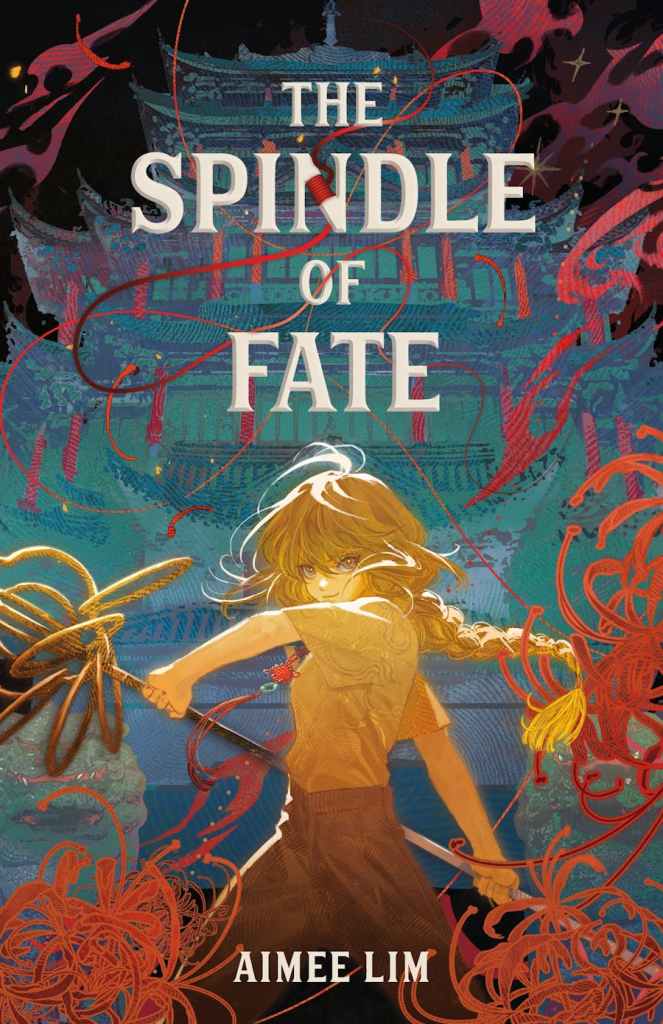
The girl who chose violence: The Spindle of Fate by Aimee Lim (ARC Review -Coming 6/4)

Disclaimer: I received an advanced reader copy (ARC) of this book for free for the purpose of giving an honest review.

The Spindle of Fate can be purchased here.
***SPOILERS***


New author Aimee Lim’s The Spindle of Fate is a middle grade fantasy drawing on an old Buddhist tale, Mulian Saves His Mother From Hell. It tells the story of Evie Mei Huang, a 12-year old girl who descends into the Chinese underworld to rescue her dead mom, who turns out to have been part of a secret magical society. Both educational and entertaining, the overarching narrative serves as a vessel to share a sampler of Chinese myths, folk tales, history, and language tidbits as it follows vengeful antihero Evie into Hell.

Personally, I think this book is horror disguised as fantasy. From depicting the Huang’s petty bourgeois world where even the magic system functions as a family business, to the literal pond of blood the kiddos have to swim in, it sets some deeply unsettling scenes. Evie herself is a horror movie fan, so I feel like it’s intentionally nudging at that genre, even if the book had to get marketed as plain fantasy. I would still say it’s appropriate for its proposed 8-12 year-old audience, as a kid that loved horror at that age myself—just a head’s up that it’s more Dante than Rick Riordan.

Evie reminded me of one of Roald Dahl’s spiteful characters, and was fun to read precisely because she’s not “good.” She doesn’t seem to like anyone, even her supposed best friend, and has a particularly carceral/punitive ethics driving her every move. Despite being given strong evidence to the contrary, Evie can’t wrap her head around the idea that the cycle of violence is bad. Instead, in order to overcome the cognitive dissonance of seeing innocent people harmed, she decides to believe they must be guilty in some way. When that fails, she allows herself to enjoy their suffering simply because she likes it. She even engages in some torture of innocents herself, using a magic staff that her forebearer Mulian once used to liberate people. Lol. One of the book’s themes is capitalist ethics superseding other values systems the Huang’s Chinese ancestors upheld, so this checks out.

At the end of the book, in one of the most psychologically disturbing moments to me, Evie is forced to smile and shake the hand of the guy who murdered her mom. Her mom’s ghost, demonstrating lackluster ethics, had made her swear not to avenge her death not because killing people is wrong, but because you might go to prison for it. But the conclusion of the book, and Evie’s almost nonexistent character arc, is that since she doesn’t believe in filial piety, she is gonna freaking murder this guy anyway, against her mom’s wishes.

I was a little confused by this ending, as the story felt like it was setting up a moment of reckoning where Evie realized, through several illustrative metaphors and potential lessons from past and present, that the best way to “avenge” her mom is actually to refuse to continue this cycle. For example, her sidekick is a boy who barely gets to see his mom because she’s off on her own revenge quest all the time. But Evie sees and then overlooks this. It’s like Hamlet if Hamlet didn’t die at the end, and decided to go on killing more people, without any repercussions for his actions.

It left me wondering what I’m supposed to take away from the story—that it’s actually a good thing to seek revenge? That everyone else was wrong and Evie was right? That money really does come before everything (for example, the only argument that showed signs of convincing Evie not to kill somebody was when she considered how it might affect online reviews of the family’s business—lmao). I’d be curious to hear how others interpret this story’s message.

One other thing that bugged me was how a last minute introduction of a bisexual character was handled. At the very end, the boy character, Kevin, gets his wish to know who he’s fated to marry. The problem is, he’s informed of his fated mate, at twelve years old, in front of a crowd of adults we don’t know much about, and it’s another boy. This is presented as totally fine. But I felt visceral shock that an adult would out him publicly in front of other adults, not only that but ones who had been shown throughout the story to be committed to a lot of traditional values and in some cases were particularly violent. When the rest of the book mentions things like colonialism and sexism, I assume homophobia exists in the world too.

I also would have preferred if the story more meaningfully engaged with Kevin’s sexuality. Like have him discover this aspect of himself through the course of the story—have him love—rather than through an adult telling him what he is at the end of the book.

But I’m still glad that such a character is on the page at all, which is a big change from when I was Kevin’s age. I’m thankful Aimee Lim wanted to make this gesture towards queer kids to let them know they’re welcome. And if the book becomes a series as it’s been set up to be able to do, I’m sure Lim would be able to expand on things like giving Evie and Kevin both more character development, and working out some of these things that felt a little underbaked.

All in all, I would recommend this book not only to young readers, but to their older friends, family, and teachers—there’s a lot here to use as a springboard for learning about other stuff together, like Chinese history and mythology, so I could see this book landing on school reading lists. Congrats to Aimee Lim on getting published—she’s a librarian, so I can imagine there will be a super cool moment when she gets to shelve the book she herself wrote!

This was my first Advanced Reader Copy review so I’m still learning the ropes, and I think I went more into analyzing the characters I was fascinated with than giving the overview someone deciding whether or not to read the book needs, but I’ll work on improving my approach for the next one.

Buy the Spindle of Fate here!

Tomb Writers: A. K. Larkwood, Tamsyn Muir, and Ursula K. Le Guin

The children yearn for the tombs…


***this post contains spoilers for A. K. Larkwood’s The Unspoken Name and Tamsyn Muir’s Gideon/Harrow the Ninth***


What is it about being a child bride to a dead god in a sepulcher deep underground that we find so relatable? Whatever it is, if you’re getting ready for Tomb Girl Summer, your reading list must include Ursula K. Le Guin, Tamsyn Muir, and A.K. Larkwood.

For this post, I wanted to focus on hyping Larkwood, who has done something special with her debut novel The Unspoken Name. But I couldn’t help but review this book in literary conversation with Le Guin and Muir. And because I’ve got a million things on my mind this week, instead of this being a standard book review, it’s more like an overflow area for connections between these three writers my brain keeps flooding with.

Like, I only found Larkwood because of Muir. I fell in love with Muir’s Gideon the Ninth a few months ago, and in an interview she mentioned being friends with Larkwood and embroidering her a blanket or something that said “Love means never having to say you’re Csorwe” which cracked me up. (Csorwe is the main character of Larkwood’s book. See? Now it’s funny.)

Anyway, Larkwood’s book performed a kind of miracle for me, and I wanted to share this happy surprise.

Atuan, Atutwo: A. K. Larkwood’s Reenvisioning of Earthsea

When I was a kid, I adored The Tombs of Atuan by Ursula Le Guin. I returned to it again and again over the years because it’s so immersive, the kind of fantasy story that feels like it literally unlocks a door between worlds. Comforting and magical at the same time, a Narnia you never get told you’re too old for.

And yet, to this date I have never read any of the other Earthsea books. Somehow I stumbled on Tombs first (it’s not the first book in the series) and stopped there. When I tried to read further, I was disappointed to find Tenar, the priestess of the tomb, didn’t remain the main character. But that Le Guin, feeling bound by sexist fantasy conventions, had to set her aside in favor of some guy wizard.

Ursula Le Guin herself expressed regret over how Earthsea manifested, quoted here as saying: “The Earthsea books as feminist literature are a total, complete bust. From my own archetypes and from my own cultural upbringing I couldn’t go down deep and come up with a woman wizard. Maybe I’ll learn to eventually but when I wrote those I couldn’t do it. I wish I could have.”

I wish Le Guin had lived to read Larkwood’s book, because I feel like A. K. Larkwood wrote the Earthsea that Le Guin envisioned writing in a better world.

I can’t express how much catharsis I felt reading The Unspoken Name. Calling it the “spiritual successor” of Tombs of Atuan isn’t enough, because it’s more like the reincarnation or second coming. Which is not to say this book ever feels derivative or like it’s purely an homage. It’s entirely its own story too.

Yet all these years, when I’ve thought about Tombs of Atuan, I’ve felt this wistful regret that it ended where it did, and never could have imagined that someone could write something that would completely wipe away that feeling. To stumble onto exactly that was a startling, lovely experience.

Now that I’ve tried to express how blown away I was, I’m going to pivot away from #LeGuining and compare and contrast The Unspoken Name with another book, Gideon the Ninth, by Tamysin Muir.

Note: Because I listened to the audiobook, I don’t know how characters’ names are spelled, and will be referring to them as I heard them. Obviously I could just google them, but I’m interested in the idea of audiobooks as a distinct medium/experience and in the potential they have for reintroducing elements of oral storytelling to the writing and enjoyment of mainstream fiction. So for experimental purposes, I’m passing on the names of these characters as I experienced them, and if you want to look like you know what you’re talking about, you shouldn’t quote me.

Note note: Speaking of Le Guin and blogging, I just learned she started a blog toward the end of her life, where she reflects on aging, and writing anecdotes and advice, and her cat’s adventures. You can find it on her website still, and some of these posts were collected into a book.

Tomb Fast, Tomb Furious: Muir vs Larkwood


Tamsyn Muir and A.K. Larkwood seem to be IRL friends and there are a not-insignificant amount of similarities between their debut novels Gideon the Ninth and The Unspoken Name, respectively. I would not be surprised if as an inside joke or something, they drafted their books based on the same prompt or list of things it needed to include.

Likely, their books emerged through shared conversations around mutual favorite authors and themes, producing two different takes on a common vocabulary/conceptual set.

I enjoyed reading Muir and Larkwood back to back; it’s similar to reading C.S. Lewis and Tolkien together, and getting additional depth out of the reading experience through the comparison of how two good friends tackling similar genres and themes can produce such divergent results. I’m early in my fiction writing journey but the dream of this kind of friendship-of-professionals is what motivates me to get out of my hobbit hole and network.

I made this compare and contrast chart of random similarities (***SPOILERS!***)

ConceptA. K. LarkwoodTamsyn Muir
What I imagine their concept for the book wasTomb of Atuan II: 2mbs of A2anThe Westing Game but written by a terminally online Samuel Taylor Coleridge.
RevenantsWeak zombies, not central to story, raised to serve necromancers, common on dying worldsPowerful, big part of lore and feature in story, come back to fight necromancers who pissed them off, literally are dead worlds 
Spellcaster/Swordswoman partnershipCsorwe (main character) is swordswoman to a powerful wizard/chancellor, Sir Thennai. Student overcoming her mentor relationship.Gideon (main character) is swordswoman to a powerful necromancer, enemies to beloveds relationship.
Librarians who kick ass and are also necromancersOranna has a masterful character arc that keeps you on your toes, and is the main antagonistPal/Cam and Abigail Pent all fit this category to a degree, but are helpful friends and not main characters
Sapphic main characters and nothing unusual about homosexuality in the world of the storyCsorwe and Shuthmili are both young women, very sweet and wholesome sapphic story of first love. Other main characters are gay as well. Gideon and Harrow are both gay women, story does not feature a traditional romance B plot between them, but they are *together.* Lots of other characters gay.
Important Tomb /
Help! I married a dead god
Csorwe betrothed to the god of death “the Unspoken and Unspeakable One,” who lives in essentially a tomb, but she escapes and denounces itGideon sworn to Harrow, the tomb priestess figure who’s basically betrothed to the body in the Locked Tomb they have both been raised to protect.
GenreFantasy, but with science fiction elementsScience fiction, but with fantasy elements
A particular narrative style characterized by contemporary cussing and somewhat “anachronistic” narrative voice for the settingGenerally, Larkwood sticks to traditional fantasy narrator voice, with a few exceptions like “Kicking the shit out of a crate of melons”Muir references a lot of memes, which sort of has an in-world reasoning for it.
“In some far-off way Gideon had always known that this would be how she went: gangbanged to death by skeletons.”
Narcissist male mentor who main character loves before learning better Csorwe and Sir ThennaiHarrow and the God Emperor

Some more in-depth comparisons:

Narration, and emotional experience reading the books

If the experience of reading a book were a relationship, Gideon the Ninth felt like a teenage obsession and The Unspoken Name felt like a slow, stable romance. I enjoyed both, but I could see them appealing to different demographics who might only click with one or the other.

With Gideon, Muir’s narrative voice is what kept me turning the page. It was charismatic, unpredictable, and laced with descriptions that spammed the dopamine button in my brain. 80% of why I enjoyed the book was the freshness of the voice (especially as read by Moira Quirk, whose distinctly capturing the voices of over a dozen characters dazzled me!).

The compelling characters and narration perhaps allow Gideon (and its sequels) to get away with a plot that’s notoriously almost incomprehensible until you finish the book and read it through a second time. It worked for me for the first two books, but I couldn’t get through the third, which asked more of me as a reader than I was ready to commit.

In contrast, Larkwood offers a more traditional narrative style, a voice that mostly dissolves into the background to let the story bloom forward. There are a few moments of what felt like breaking character for the narrator, such as the “melons” comment in the table above. Although they made me laugh, these moments felt out of place, like the author was torn between a “mature” voice and a more trendy/quippy/internet style, as Muir employs consistently. It pulled me out of the moment when these happened, even though they were fun; breaking the fourth wall in a book that otherwise isn’t written in that meta style.

While the narration had a couple of these inconsistent moments, the plotting was impressively rendered, like running your hand over the perfectly fitted joints of a piece of woodworking craftsmanship. Gideon made my heart leap, but the sense of security in promises made and kept through The Unspoken Name‘s plotting had me feeling cuddled up by the fireplace in an old quilt.

Which is not to say I wasn’t on the edge of my seat, especially with a dramatic pivot and leap forward in time after the first act. As someone currently trying to learn how to write a novel, I was awestruck at the situations Larkwood dragged her characters into and still got them out of. I periodically paused the audiobook at scenes I knew I would have shied away from taking so far, not trusting my creativity to get the character out alive without some cheap effect, and I tried to guess what Larkwood would do next. (The answer, always: blow my mind).

Cults and religious trauma

Gideon explicitly features a “cult,” but it’s more a cult in the classical sense of a maintenance of a sacred site. Throughout the series, one of the main characters has a positive relationship with the cult and her spirituality through it. There’s an actual, unstated, cult around their God Emperor, but it’s not in direct conflict with the MCs like the cults in Unspoken are (at least, not in the first two books of the series).

The cults and abusive relationship dynamics in The Unspoken Name are a major theme, as several primary characters tackle being born into and growing to eventually escape cults of various and blended types: religious, political, family, romantic.

The Kharsagi empire was my favorite aspects of the worldbuilding. I haven’t felt that nauseating sense of horror from even the actual horror genre books I’ve read this year like I have from Larkwood’s depiction of the Kharsagi’s coldly sophisticated systems of religious and political repression. I think if you’ve had any experience with religious or cult trauma, especially as a young woman, you’ll especially empathize with Csorwe and Shuthmili’s long and difficult interior journeys.

Themes: the struggle with breaking out physically but not yet mentally, with leaving one master just to end up serving another until you can recognize the cycle, the overwhelming responsibility of deciding what your life should look like for yourself, being unable to trust your own perception of reality, feeling “contaminated” etc. Through the medium of fantasy, Larkwood was able to empathetically engage with these in a way that might be more triggering to read if it were straight up fiction or nonfiction.

Worldbuilding: cultural references and influences

The Kharsagi culture is not all evil, but has a few redeeming qualities. They are big on research projects into the history of a universe with a clearly troubled past and uncertain future, which the other worlds in the book don’t seem that interested in understanding. In an alliterative paraphrase of Tennyson’s “Ulysses” (“though much is taken, much abides”), the Kharsagi scholarly motto is “Much is lost, but much lasts.” I often feel torn between old school and postmodern, Eastern and Western philosophy, tradition versus impermanence, so I appreciated this envisioning of a middle way–learning from what can be gathered of history even recognizing most of the data has disappeared, and that new, better ways are also being created.

I haven’t analyzed this in depth, so just covering what jumped out at me personally—both Muir and Larkwood appear to draw on a similar canon of influences, both Western classic literature and Millennial culture. But Muir leans into internet cultures and Gothic/Romanticism explicitly, with the direct incorporation of memes and characters named things like “Christabel” and “Annabel Lee.” While Larkwood’s worldbuilding draws more subtly on her influences, melding them together rather than directly pointing at them, as in the paraphrase of Tennyson, the echoing back to fantasy influences like Tombs of Atuan, and the subtle inclusion of orc- and elf-like races without smearing on the high fantasy tropes too thick.


Relationships

Another area where Muir and Larkwood diverge is in the treatment of toxic relationships. The relationship between the two main characters in Gideon, who follow an enemies-to-beloveds arc, is a troubled one, and the angst is part of the appeal. In Unspoken, basically every single relationship between every single character is toxic except for that between Csorwe and Shuthmili, who find a path out of their respective religious cults and narcissistic parent figures to create something entirely gentle, kind, and loving with each other.

I love that Gideon and Harrow are so nasty to each other, their banter is off the charts and their fraught relationship lays the groundwork for their eventual commitment to each other to be that much more powerful. I adore Csorwe and Shuthmili’s relationship for entirely the opposite: they never say anything mean to each other, but are both just earnestly trying to do the right thing, and that eventually brings them together. They are both respectful of each others’ differing religious backgrounds even while disagreeing and deconstructing their own. Especially in representation of a queer relationship, it’s lovely to just have love, without tragedy.

Also, in my headcanon Shuthmili is autistic. If this was indeed the intent, Larkwood did a great job with representation here too, without being hamfisted or stereotypical about it. A character who values research and rule-following, struggling to break free of the research and rules of the repressive religious cult she’s been brought up in, is a powerful story. And the respect that she and Csorwe show each other for things they have grown used to other people not taking seriously about them is just so heartwarming.

If you made it this far in my rambling about queer tomb maidens and second comings of Ursula K. Le Guin, you may just have what it takes to get through Gideon the Ninth and its even more perplexing sequels, and you are definitely in for a treat with A. K. Larkwood, queen of plotting, who would never have started this blog post with the punchline of a joke before setting it up.

Buy The Unspoken Name here!
Buy Gideon the Ninth here!
Buy The Tombs of Atuan here!
Don’t buy anything!