Using punctuation to lock readers into your protagonist’s POV

Life update! While I’m still pursuing writing, right now I’m detouring to focus specifically on developing my editing skills. Along with reading for Strange Horizons and Flash Fiction Online, I’ve taken on more freelance editing and story coaching jobs this year, and I’m working towards a copyediting certificate from UC San Diego. I thought some of the assignments I turned in for the first course in the UCSD program, a grammar intensive, might make for fun blog posts, so here’s one about using the semicolon (and other punctuation) to guide the reader through description of setting in a story, locking them into your protagonist or narrator’s POV.

Using punctuation to lock readers into your protagonist’s POV

According to The McGraw-Hill Education Handbook of English Grammar and Usage, semicolons should be reserved for instances “when the two parts of a compound sentence—the two independent clauses—are very closely related” (260). But, assuming fluid prose and sound rhetoric, all consecutive sentences from any given text may be expected to bear a degree of “close” relationship to each other. Although one can imagine two sentences side by side which bear absolutely no relation—for example, “I find it difficult to understand contemporary punctuation usage through studying examples from Moby Dick. My cat just vomited on my toe”—in practice, most writing will not contain sentences this jarringly disconnected. So how does one determine if two independent clauses are closely related enough to warrant a semicolon?

I’d like to explore this question in the context of writing fiction, particularly in describing setting. In a passage of setting description, generally the sentences are all “closely related”—they all describe the setting, lighting up aspects of place formerly obscured, like a flashlight beam in a night hiker’s hand. So when and why might a semicolon be used?

When describing setting in fiction, I try to think about where, based on the details I select, I am turning the reader’s attention, and how the reader is spatially experiencing the world of the book. If the protagonist enters a garden, I could describe the grackles in the pecan trees, the stink of stagnant pond water, or the irises wilting in the afternoon sun—details which ground the reader in a real sense of place, while also doing something to characterize the protagonist/narrator, whom the reader will infer (consciously or subconsciously) is the one noticing and pointing these things out to them. Just look at how setting informs character through the narrator in Ella Fitzgerald’s song, “Tenderly,” who describes how “the evening breeze / caressed the trees / tenderly,” compared to the narrator in T. S. Eliot’s poem, “The Love Song of J. Alfred Prufrock,” who describes “the evening spread out against the sky / like a patient etherized upon a table”!

Recognizing that description of setting is really simulation of character gaze or movement through space, an author may use punctuation to moderate that gaze or movement—and the reader’s “movement” alongside them. Punctuation may serve not simply as grammar notation or reproduction of spoken language’s rhythm, but as a lever or regulating valve for the reader’s flow through the physical world described in the text.
Then, while all the sentences in a passage of description may technically be “closely related,” different punctuation choices can influence how closely a reader feels physically proximal to what is described, depending on the effect you want to produce.

Consider this passage of setting description from Satin Island by Tom McCarthy:

There was a small window. A few feet from this there was a drape that hung along the wall: this big wrinkled curtain. I don’t know why it was there—maybe for warmth; behind it there was just a wall as far as I could tell.


Each of these sentences could be said to be equally related, because they are all describing something about the same room. But McCarthy doesn’t join them all with semicolons. He saves it for a specific impact at the end, while slowly escalating towards it through other punctuation, tightly controlling how the reader moves through and experiences the space:

First, the initial period forces the reader to come up short at the window, simulating the way one is naturally drawn to and transfixed by a source of light upon entering an otherwise dark room. Next, the colon similarly emphasizes the prominence of another detail: a peculiar curtain, which might have blended into the shadows if only a comma had preceded it. While the window is “small,” the curtain is “big,” and McCarthy’s next punctuation choices serve to magnify the oppressive curtain even further: an em-dash links question and answer bubbling in the protagonist’s mind in response to the curtain. Finally, McCarthy drops a semicolon to provoke the reader, after a tense pause, to dare to draw back the curtain.

If McCarthy had used a period here instead, the reader would not experience the sense of a continuously deeper slide into the room, as if sucked into a whirlpool. The punctuation parallelism would have made the curtain and wall seem to sit statically next to each other, two-dimensional instead of three-dimensional. The reader would know there was a wall behind the curtain—but she would not have pulled back the curtain herself to discover it.

Whenever you write a passage describing setting, return during the editing phase to interrogate its punctuation. Think about how a comma might dip a reader’s finger into the pool, where a period pushes them all the way in. Could the enclosure of one detail in parentheses better effect the reader poking their head around a corner? Consider if a colon or an em-dash announces the presence of the gothic mansion at the end of the lane—and its door, creaking open, slowly, very slowly . . .

Fencon 2025: Reflections on Intergenerational Fandom

This past weekend I had the pleasure of attending Fencon, a fan-run science fiction and fantasy convention in Dallas/Fort Worth. The convention skews towards older, Southern fans in their late forties to seventies, and as a younger millennial steeped more in Tor than Baen, I had a blast getting outside my bubble and diving into oldschool fandom, learning the history, and exploring some cultural divides.

The convention, attended by perhaps 150 people, featured panels ranging from cozy discussions on favorite books, to brainstorms on military strategy in alternate histories, to NASA scientists debating the best way to mine asteroids. Military SF author Jack Campbell gave a lovely keynote speech about respecting your readers, and other people generally, and delved into the complicated dynamics of writing military life and hierarchy. I particularly enjoyed the contributions of Baen publisher/editor-in-chief Toni Weisskopf; I could listen to her talk all day! She is incredibly humble and generous, funny as heck, and has a breathtaking mastery of the editing craft–truly a legend. Rhonda Eudaly was another leading voice at the con, whose passion for sharing resources and bringing up new writers shone in everything she did.

As a younger millenial, and someone who fell away from reading for a while in my twenties, my speculative fiction cultural touchestones are way more recent–Ann Leckie rather than C.J. Cherryh, Jeff VanderMeer rather than H. P. Lovecraft. I was as surprised by the ignorance of many older fans about the stuff I consider “big” right now as I was confronted by my own ignorance of the giants on whose shoulders we stand.

I kind of assumed even older fans would occasionally check out what’s currently bestselling, but at a number of panels, speakers confessed a lack of knowledge about developments in the genre since 2000. For example, one panel focused on the panelists’ perceived prevalence of cynical stories about brutally violent antiheroes, but my perception, based on what my peers are into, is that the hottest heroes right now (outside dark fantasy, at least) are messy but noble-hearted reformists and revolutionaries working against Empire: Ancillary Justice, A Memory Called Empire, Gideon the Ninth, the Expanse, Some Desperate Glory, etc. On the flip side, through the weekend I collected an extensive list of big names I am embarrassed to have still not yet read—Zelazny, Delany, A. E. van Vogt, Lois McMaster Bujold, C.J. Cherryh, etc. Folks were more than happy to recommend titles (and pass on 6 actual books, courtesy of Scott Cupp) to deepen my knowledge of the pre-1980’s era.

Another divide was the difference between this type of con and what its members deride as “gate shows”–huge conventions like Comic-Con and Anime Expo, that are professionally produced and intended to turn a profit. The fans in my generation and younger attend these types of cons, and don’t even know smaller cons like Fencon exist. And unless Fencon finds a way to radically transform, or use their institutional knowledge to help invent a new kind of fan-con for the new era, it’s apparently on the decline. I heard several older fans lament “the problem of graying,” and the approaching death of Fencon, and reference a similar fate that befell ConDFW (Covid didn’t help). I was surprised to feel a surge of grief myself for something I only just learned existed, and started brainstorming ways I could bring all my friends next year, perhaps reinvigorate it with new life, connect the rich, institutional knowledge of these fore-fans with the new fandoms of today. But, and I say this well aware when we’re old, we’ll probably do exactly the same thing, it seemed like many of the older folks are content to keep it as it is and grumble about younger fans and their strange ways.


Still, I had a surprisingly emotional experience at Fencon, a bittersweet sense of both reunion and loss, coming home and grieving. This is a community that grew from handmade fanzines and correspondence snail-mailed across the country, from clubs organized out of the backs of magazines, who remember taking guest speakers like Harlan Ellison and Leonard Nimoy out to the local honky-tonk for drinks. I had a glimpse of what we younger fans have missed out on: a cozy, for-us-by-us gathering of fans, artists, editors, and writers from amateur to big name, all nerding out and partying together without autograph fees or thousand-dollar costumes or the expectation that you be the very best in whatever you do. Sure, we can exchange fanfiction and fanart instantly across the internet and have extensive discourse over social media, in special Discord servers, etc. but dammit, I want something tangible!

Hearing tales of Fandom past made me pine for an actual paper zine with scribbly cartoons and hot takes and gossip that arrives in my mailbox. And yes, I know people still make zines, but it’s not the thriving culture it was, and there’s also things like perfectionism and fear of commitment that makes organizing persistent activity difficult. So many initiatives start with a burst of energy and then immediately get dropped. Why make little fan cartoons when other creators are sharing professional quality content on Instagram–who would read it? Isn’t it cringe? And why show up to a small club or fan convention if you don’t know anyone, or don’t totally feel like it that day, when you could just connect with your perfect group of people online, without leaving your house? We know we’re lonely, we know we’re missing face-to-face connection and the joy of building something together, but I think we largely just don’t know how to do it anymore. I think many of us are struggling with having been raised as consumers and/or capitalists, “creators,” but not creatives, not organizers and participants in an offline creative social life.

But I don’t want to end on a morose note. Despite the comments above, I don’t feel cynical about the newer generations, and I’m confident we will continue evolving our own forms of community and overcoming the obstacles to it. And, while this will sound like a cliche moralism, I do think we will get a head start if we make an effort to seek out the wisdom of older generations, get outside our bubbles and attend things like Fencon, and study the history of the genre even where pulpy and problematic. Likewise, I would love to see older fans fight for continuity–pass on that institutional knowledge of how to organize cons, how to bring people together, how to resolve conflicts, etc. to new generations.

One idea–Fencon has often run a “con within a con” format, where they team up with a specific fandom (this year, the 1632 universe) to bring in more numbers. What about networking with Gideon the Ninth, or Powerless, or ACOTAR fans, who don’t have a con of their own, to have a mini-con within Fencon and bridge the gap between established and brand new fandoms? Now, there’s nothing more annoying than someone rolling up, knowing nothing about what you’re doing, and telling you how to fix it, so my two cents may be worthless. But I would love something like Fencon for the next generation, and despite retiring from organizing I find it hard to turn off organizer brain, so I can’t help scheming… 

First Place for Flash Fiction – Roanoke Writers Conference

Quick update, this month I won first place at a flash fiction contest at the Roanoke Writers Conference!

The story I submitted, “She Stalks in Beauty, Like the Night,” is a slice of life high school sweetheart love story in a small town Texas. With lesbian vampires. I’m sending it out to magazines now to hopefully get it published somewhere.

It’s incredibly encouraging to conclude this first year of studying the craft of the short story by winning this award, and not simply because it feels like proof of my capability despite (oh, unceasing!) doubts. This story is a product of community, and to me the award symbolizes less my own skill and more the dear friends who have helped me in these early stages of my writing journey.

Context: I first drafted this story for the Clarion West flash fiction workshop I did over the summer, and drastically revised it based on critiques from friends I made there, to a level of quality I couldn’t have reached relying only on my own intuition and skills. Plus, I wouldn’t have heard about this conference and contest if it weren’t for a lovely friend I met through work, who herself heard about this through her library writing group. And the conference itself was a huge, collaborative effort of a community that truly believes in supporting each other and new writers.

On that note: check out the North Texas Writers Collective, sign up for their newsletter and go to next year’s Roanoke Writer Conference! They have so much to offer, particularly the community and mutual aid network behind it. The conference, organized thanks to DG Swain, Alicia Holston at the Roanoke Public Library, and many more, and packed with presentations and workshops by successful authors across genres and trad/indie publishing, was totally free. I actually personally left $50 richer than I arrived thanks to the flash fiction contest (which also completed my little goal to make $100 from speculative fiction this year!) but MORE IMPORTANTLY I left richer in information, networking, and friendship. At one point, I looked around the conference and just thought, “these are my people.” I felt like for the first time, I had found my local crew in terms of love for the craft of writing, and I’ve been continuing to meet up since then with friends I made there.

I can’t recommend this conference enough for writers in the Dallas/Fort Worth area and beyond, and I’m looking forward to what else the North Texas Writers Collective cooks up. What impressed me most was the genuine love I witnessed, writers who have “made it” turning around to uplift the next generations and share everything they can, and cultivate a collaborative and healthy community. I’ve unfortunately experienced my share of toxic communities, and a lot depends on the seeds you plant and the presence of experienced, wiser members bringing up newbies with good principles. So it was gratifying and even healing to find an intergenerational community planting good seeds.

For other new writers who are nervous about conferences and trying to figure out how to make connections and learn: just show up! I literally just showed up, not knowing anybody or what to expect, and just being present opened me to being approached by people who would share resources and encouragement and become new friends and mentors.

Some ways that stories start

This week I studied story openings! I looked at a number of short stories and novels in science fiction, fantasy, romantasy, suspense, and literary fiction. Here’s what I noticed:

  1. Starting in medio conflictu
  2. Application: some writing exercises
  3. Some Types of story openings
    1. The Founding Legend Prologue opening
    2. The Theme or Philosophy Concept opening
    3. Intriguing Clutter / Lagniappe opening
    4. “This is Real” Author Note opening
    5. Hard Action opening
    6. Soft Action opening
    7. Contemporary Day in the Life opening
    8. Fantasy Day in the Life / Hero’s Journey opening
    9. Big Game Hunter opening
    10. The Tool of the Trade opening
    11. Dialogue opening
    12. The Ensemble opening

Starting in medio conflictu

I found that one thing 99% of openings had in common was that they began with some kind of conflict. It could be epic in scale, along the lines of “Once upon a time there was a war between the Humans and the Faerie,” or of middling importance (like a fight scene or argument about something fairly important) or even super low stakes (a guy struggling to open a jar of pickles, or bickering with his sister over something almost inconsequential).

It seems like it basically doesn’t matter what the conflict is, as long as there is one. Some do retain relevance on rereading—this seems particularly common in short stories, where the opening conflict often reflects the heart of the story. In these cases, the real significance of the opening conflict is only made clear at the end of the story, giving these stories a circular quality, as in the echoing and layering “We Will Teach You How to Read” by Caroline M. Yoachim. The jar of pickles may turn out to be the key to saving the world! But this doesn’t necessarily have to be the case. I found other stories where, however dramatic the opening conflict seemed, further reading revealed it was more of a throwaway event simply for the purpose of hooking attention or setting things up. Gideon the Ninth and its sequels are notoriously built for re-reading, yet I find that the opening of Gideon, where she tries to escape her prison-home, is actually a fairly unimportant conflict, soon swept away by more relevant ones.

The opening conflict can also be a single, sustained issue, or a barrage of problems. In “Lucky Thirteen” by Tracy Clark, the singular, subtle opening conflict is the hint of difficulty in an old man’s traversing an icy path. But in “La Chingona” by Hector Acosta, in setting the scene, each sentence describes a new conflict: a church which looks like it’s flipping off God, a storm and thunder making the lights flicker. Neighbors arguing upstairs. An eviction notice. Sabaa Tahir’s An Ember in the Ashes begins with a low-stakes conflict in the form of argument between the MC and her brother, then proceeds at almost breakneck pace, introducing new exposition, mysteries, obstacles, and stakes with every line of a dialogue.

Application: some writing exercises


Some exercises and methods I’ve drawn from this are:

1. Think of opening a story or scene in terms of conflict, not simply in terms of things happening. If I’m starting with a character, ask what would stand most in opposition to their achieving their goal right then? What kind of initial conflict, however low stakes, might exemplify the main character’s overarching problem, or explain the driving forces in the world of the story, etc.

2. Try out two ways of opening a story or scene: “slow,” going long and deep on a single, sustained conflict, or “fast,” piling on the problems like an opening salvo.

3. Ask how each sentence, aspect, or scene could be modified to most maximize or imply conflict. Instead of a tree standing next to a house, the tree’s branches might beat against the window. Instead of opening with someone reading a letter, open with them having to put on their reading glasses first. Turn each line of dialogue into a rebuttal or disagreement in some way, rather than allowing characters to chat obligingly. Write a scene like those classic commercials where everything goes absurdly wrong.

4. After finishing a story, go back and ask how the opening conflict could be revised into something emblematic of the driving conflict or that foreshadows the ending.

Some Types of story openings

I also noticed some common types of story openings crop up again and again. When I start working on a fantasy novel next year I’m going to do an even deeper genre-specific dive to understand common structures and beats, but for now here’s what I’ve found across various genres, that can be helpful in thinking about where and how to begin:

The Founding Legend Prologue opening

Usually 1-3 pages. Tells the foundational myth or event in a prologue that sets the stage for the world of the story, generally followed by a first chapter which can enter straight into action scene and not require as much explanation of the magic/world because the prologue has cleared up the basics. It also helps to serve as a promise of the premise or clarify what the story is about for the reader, so even if there aren’t werewolves in the first chapter, you know to expect them. In Elantris, a single page prologue briefly explains how the city of Elantris was once great and people magically turned into immortals to live there. In The Serpent and the Wings of the Night, the prologue establishes the origin story of an important character, and that this is a world of humans vs vampires.

The Theme or Philosophy Concept opening


Can be a prologue or opening to first chapter. In The Power, a couple pages describe the book’s stance on the concept of power: “The shape of power is always the same; it is the shape of a tree[…].” The Left Hand of Darkness features the MC ruminating on a concept that led him to where he is today. Or in Anna Karenina: “All happy families are alike; each unhappy family is unhappy in its own way.”

Intriguing Clutter / Lagniappe opening

Opens with various pieces of “texture” leading us into the world of the novel, like news clippings, letters, email or text exchanges, poems, epigrams, fake author/title page, drawings, etc. (see The Power which includes many of the above). An exception is that in fantasy genre, it’s so typical to start with a map and/or dramatis personae that these do not feel like intriguing clutter and I would not consider them an in-story opening, rather I consider them frontmatter. 

“This is Real” Author Note opening

An author note references the book as if it’s real or what it describes is real. For example, Thomas More’s Utopia or Gene Wolfe claiming he has tried to translate The Book of the New Sun into English and Latinate approximations, explaining name choices and worldbuilding.

Hard Action opening

Opens in the middle of a fight scene, a raid, a dogfight, or interrogating somebody, etc. BAM hits you in the face with dramatic action. Typical of action thrillers, but also seen in fantasy or science fiction. A Broken Blade by Melissa Blair opens with the MC Opens in the middle of (really, right at the end of) interrogating a victim whose throat she slits at the end of a short scene.

Soft Action opening

Opens in the middle of an active scene (versus narration/exposition), but it’s lower stakes, not as dramatic. Gideon the Ninth opens with the dramatic situation of an escape in process, but it’s softened by humor and the fact that the character isn’t being pursued or prevented from carrying out their plan until the end of the scene.

Contemporary Day in the Life opening

See Starter Villain and many generic romance books, mystery, and contemporary horror: opens with character just going about their normal daily life activities, which each thing they do or reflect on giving a piece of information setting up the character, setting, and story to come. There needs to be some kind of driving mystery, problem, little conflict, or piece of intriguing news that drives you to keep reading among these generally humdrum details, although there is some general interest in this person just for being a person and demonstrating different quirks, complaints, gossip etc.

Fantasy Day in the Life / Hero’s Journey opening

Technically also day in the life, it starts with character waking up and/or going about their usual activities, but it looks pretty different from the contemporary one. Often because the hero is starting in a wretched village, and their status quo is wretched, whereas in Contemporary Day In Life, the status quo is generally pretty chill and pleasant. See Foundation by Mercedes Lackey, which starts with a young boy MC working in the mines. Elantris could be considered this I think, starts with character waking up and, if only very briefly, experiencing a moment of peaceful day in the life of a prince, before he’s suddenly thrown into a new reality. 

Big Game Hunter opening

It’s funny this would happen enough to be its own category, but there’s a distinct trope of opening fantasy stories with the hero hunting a deer, in many cases only to stumble on a magical creature. Hunger Games, A Court of Thorns and Roses, Eragon, and The North Wind all open like this. I guess it’s an easy way to make a character be immediately engaged in action/conflict, while still setting up the status quo before the real inciting incident. It also seems to be a trophy way to demonstrate “strong female character who don’t need no man.”

The Tool of the Trade opening

Opens by demonstrating and/or explaining some craft, technique, or trade. “The Dragonslayer of Merebarton” by K.J. Parker opens with an explanation of mending a chamberpot. “Stingers” by LaToya Jovena opens with a bartender’s perspective on life and mixing drinks as chemical processes. Can be combined with another opening, for example the Hunter opening shows an everyday skill, as does the interrogation scene mentioned in “Hard Action opening” above.

Dialogue opening

This would also count as an action opening, but one comprised mainly of dialogue between the main character and somebody else. In a short story, this will often cut straight to the chase, and comprise a conflict between the main character and their foil, love interest, or antagonist. The reverse is true in novels, where the dialogue will either be with a throwaway character, or with a beloved sibling, best friend, or comrade in arms. In a novel, the antagonist and love interest aren’t usually introduced in the opening dialogue/scene, I think because you don’t want to rush past developing the main character before introducing them. But this convention is occasionally broken, as in A Promise of Fire by Amanda Bouchet, where the love interest shows up in the first page. Like pure action, the dialogue should usually be a conflict between the two characters, although it can be low stakes, like “you look like shit,” “thanks a lot” “you sure you shouldn’t be resting?” “people depend on me” etc. Can also be combined with the Day in the Life opening, for example in Bannerless the main character comes down for breakfast, giving a glimpse of her normal daily life before she heads off to a detective assignment in an unfamiliar town.

The Ensemble opening

This may be a convention in some genres like epic fantasy and bad writing in others, like more basic fantasy. It’s an opening in which a bunch of characters are introduced, not just the main character and one or two foils or companions (I noticed most books have only 1-3 characters in the first scene). Now, this is different from an ensemble story, like Gideon the Ninth or Murder on the Orient Express, where each chapter introduces a couple more characters, until you’ve met everyone, and then the chapters sort of cycle through focusing on a couple at a time, so you can give each their deeper turn. No, this is referring to having over 3 characters in the very first scene/chapter. I am not personally a fan of this kind of opening, I feel it taxes my brain to try and hold too many characters at once right at the beginning of the book. I get them muddled up in my head since I don’t yet know them intimately on an individual level, and I also don’t get as interested with a broad sweep of characters (which can’t go as deep) versus giving me a single character or couple of characters to go deep on at first.

Updates + Poem Published in Strange Horizons!

Hi friends!

To start with the most exciting news, my speculative fiction poem “The Nameless Woman” was just published in my favorite magazine, Strange Horizons. As you can imagine, I’m dancing around and shrieking in an extremely undignified manner.

I’ve been working overtime during the summer, so have had to put the blog on hold until September. But I did manage to fit in an online flash fiction workshop with Clarion West. Here’s what else I’ve been up to, and upcoming content for blog posts:

I made some wonderful new writing friends and colleagues through Clarion West, and am setting up a Discord server for us to continue sharing critiques and resources (if you’re a beginning/intermediate writer looking for community and willing to commit to a monthly online critique exchange, please reach out for an invite!)

Through the workshop, I produced 6 short stories over the course of 6 weeks. The fast turnaround, 1000 word limit for each story, and above all the group feedback pushed me far past the level I’d been able to get to on my own so far. Perhaps the most important lesson I learned was the necessity of good critique buddies!

Overall, I was blown away how much free and low cost programming and support Clarion West offers new writers, and can’t recommend them enough. I’ll also be sharing notes and reflections from the workshop when I resume blogging.

Finally, I got to attend an in-person lecture and workshop with one of my favorite authors, Carrie Vaughn. They say to never meet your heroes, but in this case I’m so glad I did. Vaughn turned out to be not only a fantastic writer, but a skilled teacher and beyond that a truly lovely person with a kind and generous heart. I’ll soon be sharing the writing exercises we got from this lecture, and her insightful response to the question I’ve held onto for five years since I first read Bannerless and never thought I’d actually get to ask (!)

I’m currently reading On Writing Horror by the Horror Writers Association, The First Sister by Linden A. Lewis, A Canticle for Leibowitz by Walter Miller, and Pale Fire by Nabokov. I’m also re-reading several books on writing technique and want to do a review of the most helpful ones, including a few surprising finds, since when I first started this year’s goal to begin learning to write professionally, I remember the difficulty of putting together a curriculum without clear guidance.

My writing goals for the rest of the year are: apply the critiques I received to my flash fiction pieces and revise 3 for submission, focus on scene in September (write 4 scenes/week), focus on horror in October (write 1 horror short/week), workshop 3 short stories with my new critique group, and write a 50,000 word first draft of a novel for NaNoWriMo.

Hope everyone is having a great summer, remember to enjoy what there is to enjoy!

Austin

“A Fine Balance,” by Charlotte Ashley – Analysis and Plot Beat Sheet


“A Fine Balance” came out in 2016, but I have it in an anthology and recently did a deep dive analysis of the story structure. Sharing my notes here in case anyone else finds this helpful—I talk about the significance of character names, meta themes, an interestingly passive twist on a heroic figure, and outline what makes these action scenes so tight and explosive.

You can read or listen to the short story via PodCastle!

  1. Synopsis
  2. Concept / Passive heroism
  3. Structure analysis
  4. Worldbuilding / Themes
  5. Significant Names
  6. Plot Beat Sheet / Story Structure Breakdown

Synopsis

Set in a fantasy version of the Ottoman Empire, the story is told by Emin Akdari, apprentice to a Kavalye, a duelist whose engagements with her rival from the opposing ethnic group not only provide entertainment, but play a critical political-economic role in maintaining equilibrium within a divided city. Because of this unique tradition, the city doesn’t know war, and has literally not invented the concepts of “soldiers” or armies yet. However, the balance has been upset, and the city is on the verge of a crisis because the two top duelists are so godmode and their prize money so high, that either one winning stands to destroy the whole system.

The main character seems to tag along simply supporting her mistress’ mission, while being somewhat of a lackluster apprentice duelist themself. But at the climactic moment, we see that it’s just that loyalty, that diligent service, which saves the day.

Concept / Passive heroism

What’s special about this story is an intriguing story structure which refuses to “stand on only two pillars,” as the main character says. Instead of having a hero and an antagonist, there’s a compound cast of heroes: the POV main character, their mentor, their mentor’s rival, and being generous and taking the story’s moral to heart, all the characters that assist them along the way—doctors and messengers and witnesses.

On the surface, the “true” hero, the POV main character, directly undermines standard protagonist conventions: they take a backseat to their mentor, who seems like the real hero of the action, to the point of straight up curling into the fetal position to hide at the climax of the story. They have their own lengthy combat scene, but it’s almost completely irrelevant to the plot (it does a little characterization mainly)—a good example of, if something is interesting enough, it doesn’t need to strictly follow the “rules” of plotting. The main character doesn’t even get a gender. One might assume they’re a woman, as all the duelists in the world seem to be, though it’s ambiguous since their name, at least in the real language it’s pulled from, means “young man.”

However, Emin serves the role of hero in two humble, yet critical, ways. First, by their singular virtue of being a reliable servant of their mistress, encapsulated in a ritual: every day, they clean and prep their mistress’ gun, even though she never uses it. This obedient and diligent practice ends up saving the day when the time suddenly comes to use the gun. But the second and lasting way the POV main character is the hero, as is suggested at the end of the story, is by simply being Witness to the events recounted, as many others were. This witnessing and then testifying to others teaches the city, persisting through future generations long after the heroes of the story are gone, the values the heroes stood for, thus inspiring perpetual peace.

Structure analysis

On a structural level (see full breakdown below), the story does this cool thing by having the decisive action of the climax, the decisive “heroic action” of the protagonist, occur in the opening lines of the story. Only, you don’t know its significance until the end, and spend the rest of the story thinking how our “hero” isn’t heroic at all, in comparison to the superhero-esque duelists. It’s Chekhov’s gun—gun included—but with a unique spin.

There’s a lot to learn from this story about writing action scenes, as well. I’m holding onto this one for future reference writing combat beats. I break them down in the outline below, so check that out there.

I’ve been studying basic stuff like the 3 (or 4) act structure, but that’s geared towards novels and screenplays, so it’s interesting to see where short story structures diverge from or condense these points. In this case, I identify 6 acts – Setup, Part One, Interlude, Part Two, Part Three, and Resolution/Summing-Up. These parts roughly follow the given breaks in the story, with one exception. But you might also divide the story into these broad beats: Hook, Setup, First Battle, Interlude, Second Battle, Interlude, Crescendo, Third (Climactic) Battle, Climactic Moment, Resolution.

In the 3-4 act novel structure, you have an initial plot point where everything changes, from which the hero goes through three stages: reactive (act one), active (act two), heroic (act three-four). Here, the hero remains reactive throughout the course of the story, but for this story, it’s their very passivity and obedience to a higher power that makes them heroic.

You can still identify all the beats of a 3-4 act structure here, but condensed and pulling double duty. The middle point, where a twist is introduced, and the dark night moment, where a mentor or someone close to the hero is lost, happen concurrently. And the third plot point, where the real antagonist and final piece of missing information is fully revealed, and the climax where it’s all systems go, are back to back in the same scene.

As I analyze more stories, I am curious to learn how common this structure is for an action story. Perhaps it’s standard, just seems new to me because I haven’t looked closely at too many!

Worldbuilding / Themes

Set in an alternate version of Early Modern Albania, there’s a lot that appears like fantasy to an uneducated reader (me) that on further research, is actually references to real things. What I took for a fantasy spin on the word “cavalier”—”kavalye”—is literally the Turkish word for “cavalier,” and a “shashka” is an actual, historically relevant type of sword. “Dushiq,” the name of one of two peoples in the story, is a real place in Albania, where uprisings against the Ottoman Empire took place, a variation of which seems to be happening in this story. I’m not sure what “Onsen,” the name for the other peoples, is supposed to reference—the Ottomans, presumably, but was it an actual name for a Turkish place or group of people, as “Dushiq” is?

One of the most interesting terms is “sahidi,” the name for the dueling tradition/relationship. “Sahidi” doesn’t translate to “duel” as you might expect. Instead, it translates to “witness” or “testimony.” Because of the way the duels are used to settle disagreements and redistribute wealth between two opposing ethnic groups, and a form of Islam spirituality informs the characters’ decision, I think we are meant to understand, without it being outright explained, that the duels have a religious basis. They are a “testimony” to the will of God—whoever wins, God must favor that people to receive wealth.

But also, in the context of the story, our main character is the true sahidi, the witness to the events that unfold. And it’s these testimonies, stories and allegories like this one as the narrator concludes, that reinforce peace as they persist in the minds of the greater people. So that in the end, it’s not the hero of the story who defeats evil—they do, but briefly, for one instance in history. The real heroes who bring peace to their country are the witnesses, the storytellers, who collectively cultivate peace through how they pass on these stories, which heroes they affirm, and cultural values they want to preserve.

Also, at the inciting incident of the story, the Rival and apparent antagonist is spotted at the courthouse, “talking to lawyers,” and disappears down “Justice Way,” so there’s some symbolism there, and also the conflict between the traditional/religious form of conflict resolution versus the modern/military war method seeking to break or rewrite the law.

Significant Names

The characters’ names draw on Turkish, Albanian, Arabic words, and seem to reference each character’s essence. Making some guesses, since there’s a fantasy/invented slant to the names that leaves ambiguity rather than one for one translation, they are:

Emin Akdari = “Trustworthy/reliable young man” – this is this character’s whole thing, their shining single virtue on which the climactic moment rests, that they are a completely trustworthy and reliable servant to their heroic Mistress, and that the fate of the world depends on such sharing of responsibility, not simply individual heroes.

Shoanna Yildirim = “beautiful/fantastic lightning” – a fitting warrior’s name, and also evocative of how her final act will be to strike a fire into the top palace tower of her enemy, like a bolt of lightning.

Kara Ramadami = “Earth Scorched/Set alight” – also a fitting warrior’s name, and also evocative of her role in the story, in several ways. First, “lightning” and “earth set on fire” go hand in hand in the natural world, so her and her rival’s names pair together. Second, “Ramadam” recalls “Ramadan,” the Muslim period of fasting, making sacrifice to draw closer to God, like this character makes the ultimate sacrifice for the sake of peace.

Dashuri Dushku = “Tree of Love” – less clear what’s up with this name. “Dashuri” means “love,” and “Dushku” is just a last name, which does mean a type of oak tree. I feel like the main foreshadowing or symbolic point her name makes, is that one’s rival in the world of the story is not one’s enemy as it first appears, but actually one’s other half, the love of one’s life in a way, the person who makes you who you are, even if the mechanism of that is violent duels.

Plot Beat Sheet / Story Structure Breakdown


Title

+ References theme, “ a fine balance,” which will be stated in closing line of story.

Introduction
+ Hook – Opening line foreshadows climactic moment
+ Action taken in opening paragraph is actually the critical choice made to determine the course of the story, but this won’t be revealed until the very end climax sequence – Chekhov’s gun
+ Introduces the main (POV) character, who fails at basically everything except her Virtue, being a trustworthy servant of her mistress
+ Introduces main Feature character (Mentor) name-drops her Foil/Rival, and the Concept.

Part One
First half
+ First line foreshadows the theme with key words, “a pair” – theme of pairs
+ Exposition
+ Inciting incident – spotting rival on the move: hunting her will unfold rest of plot
+ Builds up characters and setting
+ Low stakes action and dialogue

Second half
+ Introduces MC’s foil/rival
+ Provides some further light exposition
+ Highlights characters

Action sequence #1 – status quo battle, still in Act One equivalent – initial failure:

  • 1. Prepares for battle
  • 2. Makes challenge, challenge accepted
  • 3. Enemy attacks first
  • 4. Result = MC injured
  • 5. Counter attack = fails
  • 6. Recovery = too slow, losing chance to riposte
  • 6.5 flash of reminder of stakes, heightening stakes
  • 7. Enemy attacks a second time
  • 8. MC retreats
  • 9. MC has an idea, change of plan/tactics
  • 9.5 exposition to setup action
  • 10. MC puts wild idea into action as enemy attacks again
  • 11. Initial success in escaping the attack
  • 12. Ultimate failure in enacting wild plan to attack back though = END
  • 13. Enemy gloats and takes prize
  • 14. Dust settles. Mentor helps to recover, assess damage, debrief and lick wounds

+ Concluding paragraph with exposition of the overall Stakes


Interlude
+ Backstory exposition more fully explaining the situation/predicament and the stakes
+ Hero recovering from injury and Mentor plotting main battle

Part Two
+ Almost full page of exposition and description setting the stage, and showing (not telling) the theme: a pair, two sides, unbalanced, and the problems caused by their being unbalanced. One paragraph shows the hero’s side, and one shows the “enemy” side.
+ Foreboding foreshadowing, you know it’s not going to end well.

Action sequence #2 – the ambush – Plot Point 1 + Brush with death combined

  • 1. Following a false lead, MC leads Mentor into danger, pursuing who they think is Rival
  • 2. Ambushed in darkness, Mentor injured by surprise attack
  • 3. Prepare for battle
  • 4. Mentor counter-attacks = success, but already wounded, & two more attackers appear
  • 5. Attackers reel confused, MC attacks = success
  • 6. Assessment – 4 attackers left, but both MC and Mentor injured, & more attackers coming. Forms new idea
  • 7. MC attacks = success (but false success, another trap not sprung yet)
  • 8. MC continues attack = Success! (But…)
  • 9. Mentor grievously wounded – reveal MC was lured away so she’d be exposed – END
  • 10. Assessment of damage, retreat/escape

+ Recovery scene, nursing wounds
+ Fast forward to next day
+ Reminder/foreshadowing subtly of the action MC took in opening paragraph, which will set up for final victory


Part Three
+ Lull beat, waiting for coming storm
+ Messenger arrives whose dialogue gives exposition, setting up for arrival of climax, introducing new details regarding antagonistic force, questions to be answers
+ Preparing for final battle sequence – safety off – pulling out all the stops – Chekhov’s gun loaded
+ Full reveal of the antagonistic force AND of Rival (not yet distinguished)
+ Showdown dialogue between Mentor and Rival, reveals character and some key exposition that’s been missing until now
+ Theme on display: the pair echo each other’s words, affirm how each has been forged by the other, two opposing sides depend on each other, and balance and trade offs between them, for peace.
+ Dialogue ends with twist: seemed to be setting up for battle, but instead, a quick and immediate victory, as Rival immediately surrenders – not part of the antagonistic force after all, even though it’s her own government, but equally its victim
+ The two rivals team up to face down the real antagonistic force, which responds with confusion, warnings

Action Sequence #3 – Climax

  • 1. Mentor draws Chekhov’s gun and fires before countdown can even begin = kills one
  • 2. Mentor fires again = kills two in a badass way
  • 3. Enemy counterattack = too late. Mentor/Rival launch clever plan.
  • 4. Rival attacks = success
  • 5. Mentor attacks = success
  • 6. Longer paragraph, enemy routed, deal sealed with final volley of attacks from Mentor/Rival
  • 7. Enemy fires while fleeing = fails. Notably, MC hides and curls into fetal position, taking as far from a heroic action as you’d expect. Will juxtapose with climactic moment.
  • 8. Rival urges MC back into action
  • 9. Dust is settling, the battle is over, but one final heroic action remains to win the war. Like in LOTR, at the end of the whole entire war, it still comes down to the climactic moment of throwing the ring in the volcano, the moment of truth that proves the hero.
  • 10. CLIMACTIC MOMENT – brings into play everything foreshadowed in the introduction of the story, and subtle reminded throughout. While on the surface, MC herself does nothing, while Mentor fires the heroic shot that ends the war, MC is the hero because of her trustworthiness as a servant – she has diligently maintained that gun since day one, is able to inform her Mistress of exactly how many bullets are left since the attack began (a single bullet) so she can decide how best to use it, and although the Mistress certainly wins the day with her individual skill, she could not have gotten to this moment without all the behind the scenes preparation MC has done consistently to equip her for this moment, again, the Theme of pairs of people who depend on each other for their success, no one person can succeed alone. —- I think having the virtue of the hero be this little virtue of being a reliable servant is so refreshing and cool to read, you don’t see that virtue too often as traditional servant/master values and little virtues in general aren’t typical main course in action stories at the moment.

Resolution / Summing Up
+
A brief handful of short paragraphs ties up the loose ends. What happened with the Mentor and Rival after that, what happened to the antagonistic force, that peace was restored and tradition preserved, balance restored.
+ Last line restates theme in new light, “no peace could stand on only two pillars, no matter how strong. The fine balance between Onsen and Dushiq, we all shared between us.” Shows that in common understanding, people see the balance of binaries, Us vs Them, Good versus Evil. And they are mostly right, that these yin and yang pairs are important. But it’s an oversimplification, for the interrelated pairing of all people. And as we saw, the least powerful, overlooked person in the story, was actually crucial to the success of who everyone else, including even herself, perceives as the “Hero” who restores balance. 
Taking storytelling seriously – 6 month progress report

Reflection

In January, I committed to seriously pursuing writing fiction as a long-term vocation. I’ve written since I was young, and had periodic years where I put serious effort into improving my writing and publishing, but have always set storytelling aside. I’ve struggled with the usual sense of inadequacy, the internalized idea it’s not a “worthwhile” pursuit or that there’s “more important” things I should focus on, and genuinely needing to overcome some challenges in my life first. But I’ve always loved writing, felt compelled to write, and it’s the one thing I know I can stick with for the rest of my life and give my all, so that’s what I’m going to do.

Looking around, I see people develop at different rates, and compared to many of my peers, I have been a slow grower. But, we all start from different places, and life has thrown me a couple extraordinary curve-balls. It took me about 30 years to sort out my priorities, and I used to worry about falling behind, about “proving myself.” But nearing my thirties, something shifted in my brain to perceive, more patiently, a different time scale. Now, I think in terms of being in it for the long haul. My goal is to have written ten novels by 2035, and maybe published one of them. It feels good to be patient with myself and give myself the time I need to actually learn this craft. I’ll be a sloth or a snail, just enjoying the doing—“I wake to sleep and take my waking slow.”

It was a challenging start to this commitment this year, because I also started working two jobs, sometimes 60 hours a week. But I have been extremely disciplined about how I use my remaining time. On work days, I tend to either study a story or writing textbook, or work on a shorter piece or exercise. Fortunately, looking back on creative writing and education courses I took in undergrad, and my own teaching experience, I’ve been able to design what I think is a pretty good syllabus for the year, which I continue to adapt and develop as I learn more. On off-days or days I only work a single job, I write 4-12 hours. Although entering this next half ofthe year, I’m cutting back because I do have a tendency to go too hard and see diminishing gains. Now I’m trying to keep it around 2-4 hours of writing a day, plus study hours. Rest and doing other stuff is important, not just for recovery and strength, but because the subconscious plays such a role in writing and needs unstructured time and space to foment, as well as new experiences to draw from.

I figure that, if I continue to work consistently and keep study widely and deeply, there’s no way I can’t be at least decent at storytelling after ten years. I have reached mastery of only a few things before, not even mastery but just being roundly competent, like getting to the point in tennis as a kid where I could compete for and actually win first place. It felt amazing. Not the winning, but the sheer possession of the craft, the deep thrill of being really very good at something. The special joy you can get out of life when you know something backwards and forwards to the point you can actually begin to innovate in the field. That’s where I want to get with writing stories. The failure for me now is if I don’t follow through, not if I never become a genius or get recognized or rich (ha!) from writing.

Of course, I’d still also love to be recognized, and to make some money from writing. That’s another thing I used to feel embarrassed about admitting, but I’m kind of done trying to impress people, I prefer to just be honest about everything. I write because I have things I want to share with other people. I want to give people a good story, relief from suffering, connection with others, useful ideas, and assistance in noticing certain beautiful things. And my life would be a lot easier and more enjoyable if I could make a living from it too, so that I could truly put all my best hours into production, doing what I love. That’s the dream.

For now, I will do my little writing exercises and write my shabby, deranged little first drafts, and hopefully start to make some writing buddies along the way, because this would be even more fun with company.

2024 Stats – 6 Month Progress Report

+ I got a poem accepted for upcoming publication in my favorite magazine, Strange Horizons (!). While I’m learning to write stories now, I’m still trying to work on poetry while I can.

+ Outlined and completed 8 chapters of a romance novel based on study of a particular niche and market. However, I decided the goal of completing a novel was one I needed to fail for now. The more practice the better at this novice stage. I can complete a lot more short stories in a year and probably learn more from that than from completing a single novel, so I pivoted to short stories starting in February.

+ I finished 8 short stories out of 14 projects. It took me a couple months to learn I needed to focus on finishing everything I start. Since then, I’ve finished everything, even though these endings are predictably abysmal, because… I haven’t been practicing endings, since I haven’t been finishing things.

+ I published 5 blog posts, including 2 book reviews (and this post :P). I also wrote a number of essays/analyses/blog posts for private reflection and learning/practice, but was selective about what I published here.

+ I developed a syllabus and disciplined practice for learning to write stories as well as a 5 year plan for moving forward with writing. This may actually be the best achievement of all, because it’s allowed me to make incremental, actual progress that I can track and know I’m not floundering.

+ I read 40 books, far more books in 6 months than I probably read in the past 3 years (below).

The biggest lessons I ‘ve learned so far about learning to write stories

1. FINISH what I start. No matter how terrible and ridiculous it makes the story, give the story a conclusion. Also applies to study–work through one textbook or story analysis at a time. Embrace that you are a beginner, that this story isn’t going to be good, that everything is practice for a much longer-term goal.

2. Set goals and steps to meet those goals, and reflect regularly (at least once a week) on progress towards the goal.

3. Break down other peoples’ stories and write in imitation of them for practice. I think this is the most effective learning strategy I’ve tried so far. Textbooks can help give you broad overviews of story structure, or different techniques, but the active/constructive learning that occurs when you break down a story yourself, then try to apply it to writing your own story, really sticks and improves your writing the most. Across history, artists learned through direct imitation of the masters. When you read something more than once, break it down and analyze it, and try to write in imitation of it, you really lock in the information and learn in a way you don’t retain just reading stuff passively. Had to learn to read for writing.

4. Similarly, when stumped, study more. Feeling stuck or “writer’s block” is often a case of simply trying to summon stuff up out of thin air, instead of going out and finding the information you need to move forward. When I haven’t known how to proceed, it was usually because I either didn’t actually know enough about the art of writing a story, or I hadn’t fleshed out my characters, concept, etc. enough to project what would happen next (often a combination of both). Here, studying how other authors have handled an issue is again helpful, as well as becoming more knowledgeable about my limits, what I’m actually capable of writing at this level, etc.

5. General technique stuff. Not gonna list it all out here. Just the base matter you have to accumulate as a beginner, a chaotic blend of information and half-baked ideas and dawning awareness of things you don’t yet understand, which the coming years of further practice will refine into something meaningful.

6. A grounded perspective.
Working at a book store has been really helpful to give me a humbling, but also encouraging sense of perspective about the business/publishing side of writing, and who readers are. I’ve seen how books come and go on the shelves, with even great writers eventually circulated off to make way for the new big thing, and it’s made me realize that like everything else in life, the world of books is actually in a constant state of change. Just because someone is big right now doesn’t mean it will last forever, and just because someone is small right now doesn’t mean that, after another twenty years or publishing five more books, they don’t become huge. It’s helped me plan the rest of life accordingly, understanding I won’t be able to make a living writing fiction (at least not any time soon), and to stop seeing the options as “failure” or “famous” and instead as “all you can do is work consistently, love the work itself, and hope for good fortune.” Working with a lot of different readers (coworkers and customers), has also given me a better grasp of audiences, trends, marketing, commerciality, and the need to factor these into writing I want to make money from, when I get to that point.

Maybe I’ll check in again at the end of the year and see what’s changed. I feel like it took me this long just to kind of figure out what my process needed to look like, learning strategies and resources, how to organize my time for this, etc. so hopefully the next six months will show a slightly accelerated progress! 

Books I’ve read so far this year

NB: Many of these I “read”—listened to, actually—thanks in large part to audiobooks via Libby, since many days I have 2-3 hours of cumulative commute time. 

Jeff VanderMeer –  Southern Reach Trilogy (while it remains a trilogy), Hummingbird Salamander, and Borne
Tamsyn Muir – The Locked Tomb trilogy (pending book four)
Asimiov – Left Hand of the Electron
A. K. Larkwood – The Unspoken Name
Mary Ann Shaffer & Annie Barrows – The Guernsey Literary and Potato Peel Society
Aimee Lim – Spindle of Fate
Arkady Martyne – A Memory Called Empire
Sarah J. Maas – A Court of Thorns & Roses
Amal El-Mohtar & Max Gladstone – This Is How You Lose the Time War
Ted Chiang – Exhalation
Sayaka Murata – Convenience Store Woman
Rachel Harrison – Cackle
Ann Leckie – the Imperial Radch trilogy
Hiron Ennes – Leech
Meg Cabot – Enchanted to Meet You
Mira Grant – Kingdom of Needle and Bone
Lisa Jewell – None of This is True
Catriona Ward – Sundial
Gillian Flynn – The Grownup
Melissa Marr – Remedial Magic
Lana Harper – In Charm’s Way
Larry Brooks – Story Engineering
Gwen Hayes – Romancing the Beat
Thich Nhat Hahn – The Heart of the Buddha’s Teaching
Agustina Bazterrica – Tender is the Flesh
Jack Woodford – Plotting for Every Kind of Writing
Kate Wilhelm – Storyteller
Carlo Rovelli – Helgoland
H. P. Lovecraft – The Shadow Over Innsmouth
Ryu Murakami – Piercing
Ralph Bauer – An Inca Account of the Conquest of Peru
Jane Goodall – The Book of Hope

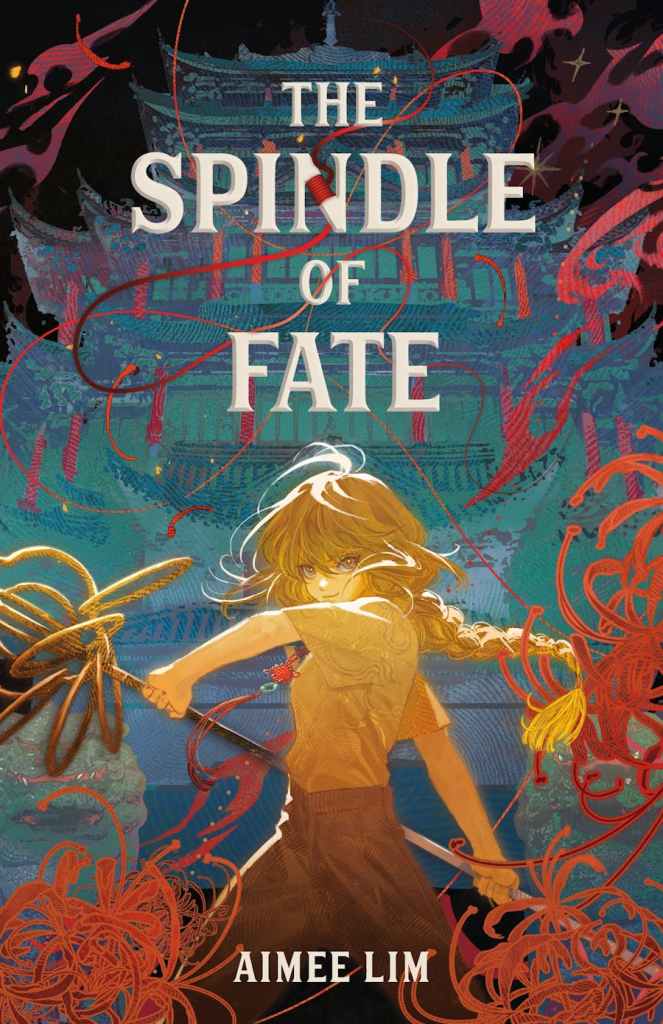
The girl who chose violence: The Spindle of Fate by Aimee Lim (ARC Review -Coming 6/4)

Disclaimer: I received an advanced reader copy (ARC) of this book for free for the purpose of giving an honest review.

The Spindle of Fate can be purchased here.
***SPOILERS***


New author Aimee Lim’s The Spindle of Fate is a middle grade fantasy drawing on an old Buddhist tale, Mulian Saves His Mother From Hell. It tells the story of Evie Mei Huang, a 12-year old girl who descends into the Chinese underworld to rescue her dead mom, who turns out to have been part of a secret magical society. Both educational and entertaining, the overarching narrative serves as a vessel to share a sampler of Chinese myths, folk tales, history, and language tidbits as it follows vengeful antihero Evie into Hell.

Personally, I think this book is horror disguised as fantasy. From depicting the Huang’s petty bourgeois world where even the magic system functions as a family business, to the literal pond of blood the kiddos have to swim in, it sets some deeply unsettling scenes. Evie herself is a horror movie fan, so I feel like it’s intentionally nudging at that genre, even if the book had to get marketed as plain fantasy. I would still say it’s appropriate for its proposed 8-12 year-old audience, as a kid that loved horror at that age myself—just a head’s up that it’s more Dante than Rick Riordan.

Evie reminded me of one of Roald Dahl’s spiteful characters, and was fun to read precisely because she’s not “good.” She doesn’t seem to like anyone, even her supposed best friend, and has a particularly carceral/punitive ethics driving her every move. Despite being given strong evidence to the contrary, Evie can’t wrap her head around the idea that the cycle of violence is bad. Instead, in order to overcome the cognitive dissonance of seeing innocent people harmed, she decides to believe they must be guilty in some way. When that fails, she allows herself to enjoy their suffering simply because she likes it. She even engages in some torture of innocents herself, using a magic staff that her forebearer Mulian once used to liberate people. Lol. One of the book’s themes is capitalist ethics superseding other values systems the Huang’s Chinese ancestors upheld, so this checks out.

At the end of the book, in one of the most psychologically disturbing moments to me, Evie is forced to smile and shake the hand of the guy who murdered her mom. Her mom’s ghost, demonstrating lackluster ethics, had made her swear not to avenge her death not because killing people is wrong, but because you might go to prison for it. But the conclusion of the book, and Evie’s almost nonexistent character arc, is that since she doesn’t believe in filial piety, she is gonna freaking murder this guy anyway, against her mom’s wishes.

I was a little confused by this ending, as the story felt like it was setting up a moment of reckoning where Evie realized, through several illustrative metaphors and potential lessons from past and present, that the best way to “avenge” her mom is actually to refuse to continue this cycle. For example, her sidekick is a boy who barely gets to see his mom because she’s off on her own revenge quest all the time. But Evie sees and then overlooks this. It’s like Hamlet if Hamlet didn’t die at the end, and decided to go on killing more people, without any repercussions for his actions.

It left me wondering what I’m supposed to take away from the story—that it’s actually a good thing to seek revenge? That everyone else was wrong and Evie was right? That money really does come before everything (for example, the only argument that showed signs of convincing Evie not to kill somebody was when she considered how it might affect online reviews of the family’s business—lmao). I’d be curious to hear how others interpret this story’s message.

One other thing that bugged me was how a last minute introduction of a bisexual character was handled. At the very end, the boy character, Kevin, gets his wish to know who he’s fated to marry. The problem is, he’s informed of his fated mate, at twelve years old, in front of a crowd of adults we don’t know much about, and it’s another boy. This is presented as totally fine. But I felt visceral shock that an adult would out him publicly in front of other adults, not only that but ones who had been shown throughout the story to be committed to a lot of traditional values and in some cases were particularly violent. When the rest of the book mentions things like colonialism and sexism, I assume homophobia exists in the world too.

I also would have preferred if the story more meaningfully engaged with Kevin’s sexuality. Like have him discover this aspect of himself through the course of the story—have him love—rather than through an adult telling him what he is at the end of the book.

But I’m still glad that such a character is on the page at all, which is a big change from when I was Kevin’s age. I’m thankful Aimee Lim wanted to make this gesture towards queer kids to let them know they’re welcome. And if the book becomes a series as it’s been set up to be able to do, I’m sure Lim would be able to expand on things like giving Evie and Kevin both more character development, and working out some of these things that felt a little underbaked.

All in all, I would recommend this book not only to young readers, but to their older friends, family, and teachers—there’s a lot here to use as a springboard for learning about other stuff together, like Chinese history and mythology, so I could see this book landing on school reading lists. Congrats to Aimee Lim on getting published—she’s a librarian, so I can imagine there will be a super cool moment when she gets to shelve the book she herself wrote!

This was my first Advanced Reader Copy review so I’m still learning the ropes, and I think I went more into analyzing the characters I was fascinated with than giving the overview someone deciding whether or not to read the book needs, but I’ll work on improving my approach for the next one.

Buy the Spindle of Fate here!

The Bookshelf Ecosystem

Notes from the Bookstore Sales Floor, Episode 2

Welcome to episode two of Notes from the Bookstore Sales Floor where I, someone who knows little about either writing or selling books (yet!), presume to teach you about both. For the start of this blog series, check out episode 1, about who buys all these books anyway? here.

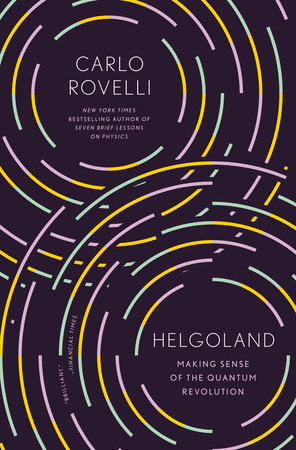
[Image via Penguin Random House. Cover design by Amanda Dewey]


I’m currently reading Carlo Rovelli’s Helgoland, about the origin and philosophical implications of quantum physics. One of Rovelli’s main arguments is that the essence of reality is fundamentally made of relationships, not substances: “[Things] do nothing but continuously act upon each other. To understand nature, we must focus on these interactions rather than on isolated objects.”

With this on my mind, I’ve started looking at the bookshelves of Big Name Bookstore (BN for short), where I work, as a living ecosystem of relations.

Bookstore shelves are an environment more dynamic and fascinating than one might suppose at first glance. They are continuously acted upon by the people in the store (and everything else, according to Rovelli, but we’ll focus on the people), and they themselves act upon people, by design and coincidence.

You choose to pick up a book based on a combination of internal factors (your preferences, history, mood, etc.) and external factors (the book’s cover, marketing, placement on the shelf, etc.). Or rather, you do not pick up the book, and the book does not make you pick it up, but you and the book emerge in relationship with each other.

It’s difficult to wrap your brain around, but I envision this emergence in the way that music emerges only in the relationship of violin bow, tuned string, player, and composition, and can’t just come into being on its own or hang around in the air without something producing and reproducing it.

Similarly, a book emerges on a shelf through relations of writer, publisher, workers producing the physical book-object, the sunlight that went into the trees that went into the pages, etc. And the composition or activity of the broader bookshelf also continuously changes and evolves. 

Most fascinating, in my opinion, is how booksellers and visitors alike engage with the shelves in a kind of guerrilla warfare, or evolutionary struggle, with all the spontaneous organization and furtive acts of sabotage that entails.

I’ve already talked about some of the factors at play in my first “Notes from the Bookstore Sales Floor,” regarding the impact of promotion (or lack thereof) and regular book buyer behavior on what happens to a book at the store. But here I’ll look a bit more at how booksellers and visitors operate as active subjects in relation:

Booksellers: are people, and unpredictable

 
Outside of bestselling books, whose promotion can’t be avoided, which books are featured on a shelf can largely fall to the whims and interests of the store’s booksellers. They are human beings, so they bring to their work a complex relation of motivations, ethical beliefs, areas of expertise, physical states like enthusiasm or fatigue, limitations… like being too short to reach the top shelf and organize it… etc. The relations between these shape the actions of the bookseller, and the actions of the bookseller shape the shelf, and through it, the actions of customers and their interest or ability to buy a book.

I was organizing a shelf yesterday and found a book that had, perplexingly, been shelved under the name of the testimonial in small print beneath the title. The cover quoted something like “‘Great book, 10/10’ – Michael Scott,” and so the bookseller had shelved it under “Scott”… Even though the author’s name sat in very large print just above that, and was the only name on the spine. Some mysterious set of relations produced an action the author and publisher could have never accounted for, which made this book effectively disappear from access for who knows how long.

Another example: the vast majority of my coworkers are romance/romantasy/YA readers. So these sections in our store remain impeccably “gardened”—regularly checked and lovingly maintained. The sections closest to customer service, the hub at the center of the store where employees congregate, are also better maintained on average. But sections hosting genres our booksellers aren’t personally invested in, like science, Spanish-language, and true crime, are disasters. Or were, because I personify everything and fall in love with the overlooked and bullied, so I took these areas under my wing like orphaned baby birds.

Case study: my own shelving behavior


To do a deeper dive into bookseller-as-relation, here’s what I’ve noticed about myself.

For my part, when I approach a shelf that needs some books faced-out (cover turned out to highlight the title), and it doesn’t matter which, I tend to promote books based on four basic impulses: fidelity, empathy, sense of humor, and ethics.

Fidelity means I highlight books I love and feel a devotion to because of what they’ve helped me become. I say fidelity and not just affinity, because it feels almost like an indebted sense of duty to pass these books on. I look out for the authors I grew up with like Ursula K. Le Guin, Diana Wynne Jones, and C.S. Lewis, and the authors I’m fanning for lately like Jeff VanderMeer, Tamsyn Muir, and Ann Leckie (also A. K. Larkwood, who isn’t on our shelves sadly, but who I highly recommend—The Unspoken Name is basically the glorious second coming of Le Guin’s Tombs of Atuan, and reads like what it would have been if Le Guin had felt free from male readership bias to let Tenar lead the story and also have a cute gay romance).

Anyway, continuing on: Empathy means books that haven’t been promoted well, yet seem good. I offer my support to these Davids against the Goliaths of authors like Patterson and Brandon Sanderson hulking across the shelves next to them. Because these are books in which I can see myself. Imagining one day I will publish a book that only gets a single ignominious copy sent to the store, I try to give these little friends a boost up.

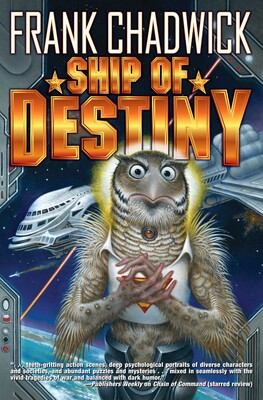
Sense of humor is usually invoked when I encounter an absurd, oddball cover or an amusing juxtaposition on the shelf. Ship of Destiny by Frank Chadwick is one of my most beloved covers—I can NOT stop laughing at this perturbed owl in a crop top who’s about to kick your ass—so I face it out periodically. Sincere shout out to the artist, Don Maitz, who offers some lovely reflections on craft and cover design here. An example of juxtaposition: in the science section, I like to face out a Stephen Hawking book next to Hawking Hawking by Charles Seife, which condemns the scientist as something of a charlatan, and let this conflict potentially draw in a reader.

[Image credit: Simon and Schuster, cover art by Don Maitz]

Ethical means if I think your book is literally evil, such as encouraging violence or dehumanization of people, I will not help promote it. BN sells more than a few books which advocate for the abuse, dehumanization, and death of people like me, and other minority groups. This is fucked up enough already without me obligingly aiding in their promotion.

Overall, these aren’t conscious guiding principles in how I shelve, but were largely unconscious behaviors to me until I critically reflected on what I do. There are all kinds of processes, conscious and unconscious, that go into the promotion of books at this ground level, and I’d be curious how other booksellers conceptualize their relation to the shelves.

[Nota bene: if you enjoy wacky cover art, check out Funny as Shit Book Covers and r/badscificovers]

Visitors: the left hand of bookselling

Along with bookseller influence over shelving, there’s the even more chaotic element of visitors to the store. (I say “visitors,” not “customers,” because they don’t necessarily come to buy anything). Visitors are not so different from booksellers as you might think, but like the electron to their proton, they participate in the same practice with a different charge: they have just as much access to shelves and control over shelving as booksellers, with none of the responsibility.

Periodically, they awaken to consciousness of this latent power.

Just like booksellers, visitors shelve books, reorganize shelves, choose what to feature and face-out, and what to remove and discontinue. But as the trickster fairy version of staff, they shelve books according to impulse and malice, rather than alphabetically. They re-home books to different sections, sometimes out of carelessness, other times intentionally; for example, often I see Bibles shelved in Self Help by Christians, and in Fiction by Atheists.

Visitors have their own form of face-out, I call “faceover.” They face-out a book over an already faced-out different book, hiding the one and promoting the other. This may cause booksellers to overlook the problem for a while, especially if both books are the same dimensions, assuming they are the same book. It’s like a brood parasite, a cuckoo overtaking a nest.

Visitors also have another technique, which I call “edging” because these are not serious terms. This is when instead of shelving the book with the spine out, they turn it 180 degrees so all you see are pages. This is most often used as a camouflage technique and act of protest, to hamper the sale of certain books. Currently, our most frequently edged books are Ron DeSantis’ The Courage to be Free and all our books about Israel, but especially Israel, a history by Martin Gilbert, which would otherwise feature prominently on the shelf with its many, hefty copies. Visitors will apply a moral judgment to the shelf, to a degree most booksellers avoid, since they have to worry about keeping their jobs.  

Insights for authors: I’m sure everything averages out on a large scale, and a lot of what I’m describing here are odd flukes and strange maneuvering, outlier situations and mutations. But these peculiarities do have effects as unpredictable as they are undeniable, and may be worth considering if you’re involved in the book trade. 

Personally, my chaotic neutral side kind of loves that millions of dollars and years of work can go into producing, marketing, and promoting a book only to be undone in a second by some punk walking in off the street and flipping it around back to front. 

But if you don’t love this, then it should increase your respect for the diligent work of the noble booksellers who, despite only getting paid $11 an hour (💀), walk miles per shift circling the store and fixing displays, putting your book back where it can be easily found by a reader, and perhaps even giving you a helping hand as a newer author.

There’s so much more I’d like to analyze, and may try to tackle, in a future post about the art of shelving, BN versus American Library Association standards, fun terminology (I love learning about the vocabularies of different trades and practices), and following Carlo Rovelli, thinking about the relations of books and people. But for now I’ll leave it here.

If you engage with books, whether as an author, bookseller, reader, etc. what is a (perhaps unusual) way you’ve found yourself making an intervention in this ecosystem? I would love to hear anecdotes from others’ experiences!

Tomb Writers: A. K. Larkwood, Tamsyn Muir, and Ursula K. Le Guin

The children yearn for the tombs…


***this post contains spoilers for A. K. Larkwood’s The Unspoken Name and Tamsyn Muir’s Gideon/Harrow the Ninth***


What is it about being a child bride to a dead god in a sepulcher deep underground that we find so relatable? Whatever it is, if you’re getting ready for Tomb Girl Summer, your reading list must include Ursula K. Le Guin, Tamsyn Muir, and A.K. Larkwood.

For this post, I wanted to focus on hyping Larkwood, who has done something special with her debut novel The Unspoken Name. But I couldn’t help but review this book in literary conversation with Le Guin and Muir. And because I’ve got a million things on my mind this week, instead of this being a standard book review, it’s more like an overflow area for connections between these three writers my brain keeps flooding with.

Like, I only found Larkwood because of Muir. I fell in love with Muir’s Gideon the Ninth a few months ago, and in an interview she mentioned being friends with Larkwood and embroidering her a blanket or something that said “Love means never having to say you’re Csorwe” which cracked me up. (Csorwe is the main character of Larkwood’s book. See? Now it’s funny.)

Anyway, Larkwood’s book performed a kind of miracle for me, and I wanted to share this happy surprise.

Atuan, Atutwo: A. K. Larkwood’s Reenvisioning of Earthsea

When I was a kid, I adored The Tombs of Atuan by Ursula Le Guin. I returned to it again and again over the years because it’s so immersive, the kind of fantasy story that feels like it literally unlocks a door between worlds. Comforting and magical at the same time, a Narnia you never get told you’re too old for.

And yet, to this date I have never read any of the other Earthsea books. Somehow I stumbled on Tombs first (it’s not the first book in the series) and stopped there. When I tried to read further, I was disappointed to find Tenar, the priestess of the tomb, didn’t remain the main character. But that Le Guin, feeling bound by sexist fantasy conventions, had to set her aside in favor of some guy wizard.

Ursula Le Guin herself expressed regret over how Earthsea manifested, quoted here as saying: “The Earthsea books as feminist literature are a total, complete bust. From my own archetypes and from my own cultural upbringing I couldn’t go down deep and come up with a woman wizard. Maybe I’ll learn to eventually but when I wrote those I couldn’t do it. I wish I could have.”

I wish Le Guin had lived to read Larkwood’s book, because I feel like A. K. Larkwood wrote the Earthsea that Le Guin envisioned writing in a better world.

I can’t express how much catharsis I felt reading The Unspoken Name. Calling it the “spiritual successor” of Tombs of Atuan isn’t enough, because it’s more like the reincarnation or second coming. Which is not to say this book ever feels derivative or like it’s purely an homage. It’s entirely its own story too.

Yet all these years, when I’ve thought about Tombs of Atuan, I’ve felt this wistful regret that it ended where it did, and never could have imagined that someone could write something that would completely wipe away that feeling. To stumble onto exactly that was a startling, lovely experience.

Now that I’ve tried to express how blown away I was, I’m going to pivot away from #LeGuining and compare and contrast The Unspoken Name with another book, Gideon the Ninth, by Tamysin Muir.

Note: Because I listened to the audiobook, I don’t know how characters’ names are spelled, and will be referring to them as I heard them. Obviously I could just google them, but I’m interested in the idea of audiobooks as a distinct medium/experience and in the potential they have for reintroducing elements of oral storytelling to the writing and enjoyment of mainstream fiction. So for experimental purposes, I’m passing on the names of these characters as I experienced them, and if you want to look like you know what you’re talking about, you shouldn’t quote me.

Note note: Speaking of Le Guin and blogging, I just learned she started a blog toward the end of her life, where she reflects on aging, and writing anecdotes and advice, and her cat’s adventures. You can find it on her website still, and some of these posts were collected into a book.

Tomb Fast, Tomb Furious: Muir vs Larkwood


Tamsyn Muir and A.K. Larkwood seem to be IRL friends and there are a not-insignificant amount of similarities between their debut novels Gideon the Ninth and The Unspoken Name, respectively. I would not be surprised if as an inside joke or something, they drafted their books based on the same prompt or list of things it needed to include.

Likely, their books emerged through shared conversations around mutual favorite authors and themes, producing two different takes on a common vocabulary/conceptual set.

I enjoyed reading Muir and Larkwood back to back; it’s similar to reading C.S. Lewis and Tolkien together, and getting additional depth out of the reading experience through the comparison of how two good friends tackling similar genres and themes can produce such divergent results. I’m early in my fiction writing journey but the dream of this kind of friendship-of-professionals is what motivates me to get out of my hobbit hole and network.

I made this compare and contrast chart of random similarities (***SPOILERS!***)

ConceptA. K. LarkwoodTamsyn Muir
What I imagine their concept for the book wasTomb of Atuan II: 2mbs of A2anThe Westing Game but written by a terminally online Samuel Taylor Coleridge.
RevenantsWeak zombies, not central to story, raised to serve necromancers, common on dying worldsPowerful, big part of lore and feature in story, come back to fight necromancers who pissed them off, literally are dead worlds 
Spellcaster/Swordswoman partnershipCsorwe (main character) is swordswoman to a powerful wizard/chancellor, Sir Thennai. Student overcoming her mentor relationship.Gideon (main character) is swordswoman to a powerful necromancer, enemies to beloveds relationship.
Librarians who kick ass and are also necromancersOranna has a masterful character arc that keeps you on your toes, and is the main antagonistPal/Cam and Abigail Pent all fit this category to a degree, but are helpful friends and not main characters
Sapphic main characters and nothing unusual about homosexuality in the world of the storyCsorwe and Shuthmili are both young women, very sweet and wholesome sapphic story of first love. Other main characters are gay as well. Gideon and Harrow are both gay women, story does not feature a traditional romance B plot between them, but they are *together.* Lots of other characters gay.
Important Tomb /
Help! I married a dead god
Csorwe betrothed to the god of death “the Unspoken and Unspeakable One,” who lives in essentially a tomb, but she escapes and denounces itGideon sworn to Harrow, the tomb priestess figure who’s basically betrothed to the body in the Locked Tomb they have both been raised to protect.
GenreFantasy, but with science fiction elementsScience fiction, but with fantasy elements
A particular narrative style characterized by contemporary cussing and somewhat “anachronistic” narrative voice for the settingGenerally, Larkwood sticks to traditional fantasy narrator voice, with a few exceptions like “Kicking the shit out of a crate of melons”Muir references a lot of memes, which sort of has an in-world reasoning for it.
“In some far-off way Gideon had always known that this would be how she went: gangbanged to death by skeletons.”
Narcissist male mentor who main character loves before learning better Csorwe and Sir ThennaiHarrow and the God Emperor

Some more in-depth comparisons:

Narration, and emotional experience reading the books

If the experience of reading a book were a relationship, Gideon the Ninth felt like a teenage obsession and The Unspoken Name felt like a slow, stable romance. I enjoyed both, but I could see them appealing to different demographics who might only click with one or the other.

With Gideon, Muir’s narrative voice is what kept me turning the page. It was charismatic, unpredictable, and laced with descriptions that spammed the dopamine button in my brain. 80% of why I enjoyed the book was the freshness of the voice (especially as read by Moira Quirk, whose distinctly capturing the voices of over a dozen characters dazzled me!).

The compelling characters and narration perhaps allow Gideon (and its sequels) to get away with a plot that’s notoriously almost incomprehensible until you finish the book and read it through a second time. It worked for me for the first two books, but I couldn’t get through the third, which asked more of me as a reader than I was ready to commit.

In contrast, Larkwood offers a more traditional narrative style, a voice that mostly dissolves into the background to let the story bloom forward. There are a few moments of what felt like breaking character for the narrator, such as the “melons” comment in the table above. Although they made me laugh, these moments felt out of place, like the author was torn between a “mature” voice and a more trendy/quippy/internet style, as Muir employs consistently. It pulled me out of the moment when these happened, even though they were fun; breaking the fourth wall in a book that otherwise isn’t written in that meta style.

While the narration had a couple of these inconsistent moments, the plotting was impressively rendered, like running your hand over the perfectly fitted joints of a piece of woodworking craftsmanship. Gideon made my heart leap, but the sense of security in promises made and kept through The Unspoken Name‘s plotting had me feeling cuddled up by the fireplace in an old quilt.

Which is not to say I wasn’t on the edge of my seat, especially with a dramatic pivot and leap forward in time after the first act. As someone currently trying to learn how to write a novel, I was awestruck at the situations Larkwood dragged her characters into and still got them out of. I periodically paused the audiobook at scenes I knew I would have shied away from taking so far, not trusting my creativity to get the character out alive without some cheap effect, and I tried to guess what Larkwood would do next. (The answer, always: blow my mind).

Cults and religious trauma

Gideon explicitly features a “cult,” but it’s more a cult in the classical sense of a maintenance of a sacred site. Throughout the series, one of the main characters has a positive relationship with the cult and her spirituality through it. There’s an actual, unstated, cult around their God Emperor, but it’s not in direct conflict with the MCs like the cults in Unspoken are (at least, not in the first two books of the series).

The cults and abusive relationship dynamics in The Unspoken Name are a major theme, as several primary characters tackle being born into and growing to eventually escape cults of various and blended types: religious, political, family, romantic.

The Kharsagi empire was my favorite aspects of the worldbuilding. I haven’t felt that nauseating sense of horror from even the actual horror genre books I’ve read this year like I have from Larkwood’s depiction of the Kharsagi’s coldly sophisticated systems of religious and political repression. I think if you’ve had any experience with religious or cult trauma, especially as a young woman, you’ll especially empathize with Csorwe and Shuthmili’s long and difficult interior journeys.

Themes: the struggle with breaking out physically but not yet mentally, with leaving one master just to end up serving another until you can recognize the cycle, the overwhelming responsibility of deciding what your life should look like for yourself, being unable to trust your own perception of reality, feeling “contaminated” etc. Through the medium of fantasy, Larkwood was able to empathetically engage with these in a way that might be more triggering to read if it were straight up fiction or nonfiction.

Worldbuilding: cultural references and influences

The Kharsagi culture is not all evil, but has a few redeeming qualities. They are big on research projects into the history of a universe with a clearly troubled past and uncertain future, which the other worlds in the book don’t seem that interested in understanding. In an alliterative paraphrase of Tennyson’s “Ulysses” (“though much is taken, much abides”), the Kharsagi scholarly motto is “Much is lost, but much lasts.” I often feel torn between old school and postmodern, Eastern and Western philosophy, tradition versus impermanence, so I appreciated this envisioning of a middle way–learning from what can be gathered of history even recognizing most of the data has disappeared, and that new, better ways are also being created.

I haven’t analyzed this in depth, so just covering what jumped out at me personally—both Muir and Larkwood appear to draw on a similar canon of influences, both Western classic literature and Millennial culture. But Muir leans into internet cultures and Gothic/Romanticism explicitly, with the direct incorporation of memes and characters named things like “Christabel” and “Annabel Lee.” While Larkwood’s worldbuilding draws more subtly on her influences, melding them together rather than directly pointing at them, as in the paraphrase of Tennyson, the echoing back to fantasy influences like Tombs of Atuan, and the subtle inclusion of orc- and elf-like races without smearing on the high fantasy tropes too thick.


Relationships

Another area where Muir and Larkwood diverge is in the treatment of toxic relationships. The relationship between the two main characters in Gideon, who follow an enemies-to-beloveds arc, is a troubled one, and the angst is part of the appeal. In Unspoken, basically every single relationship between every single character is toxic except for that between Csorwe and Shuthmili, who find a path out of their respective religious cults and narcissistic parent figures to create something entirely gentle, kind, and loving with each other.

I love that Gideon and Harrow are so nasty to each other, their banter is off the charts and their fraught relationship lays the groundwork for their eventual commitment to each other to be that much more powerful. I adore Csorwe and Shuthmili’s relationship for entirely the opposite: they never say anything mean to each other, but are both just earnestly trying to do the right thing, and that eventually brings them together. They are both respectful of each others’ differing religious backgrounds even while disagreeing and deconstructing their own. Especially in representation of a queer relationship, it’s lovely to just have love, without tragedy.

Also, in my headcanon Shuthmili is autistic. If this was indeed the intent, Larkwood did a great job with representation here too, without being hamfisted or stereotypical about it. A character who values research and rule-following, struggling to break free of the research and rules of the repressive religious cult she’s been brought up in, is a powerful story. And the respect that she and Csorwe show each other for things they have grown used to other people not taking seriously about them is just so heartwarming.

If you made it this far in my rambling about queer tomb maidens and second comings of Ursula K. Le Guin, you may just have what it takes to get through Gideon the Ninth and its even more perplexing sequels, and you are definitely in for a treat with A. K. Larkwood, queen of plotting, who would never have started this blog post with the punchline of a joke before setting it up.

Buy The Unspoken Name here!
Buy Gideon the Ninth here!
Buy The Tombs of Atuan here!
Don’t buy anything!